Friday, August 7, 2015

Interpretation of Arterial Blood Gases by American Thoracic Society

Interpreting an arterial blood gas (ABG) is a crucial skill for physicians, nurses, respiratory therapists, and other health care personnel. ABG interpretation is especially important in critically ill patients.
The following six-step process helps ensure a complete interpretation of every ABG. In addition, you will find tables that list commonly encountered acid-base disorders.
Many methods exist to guide the interpretation of the ABG. This discussion does not include some methods, such as analysis of base excess or Stewart’s strong ion difference. A summary of these techniques can be found in some of the suggested articles. It is unclear whether these alternate methods offer clinically important advantages over the presented approach, which is based on the “anion gap.”
http://www.thoracic.org/professionals/clinical-resources/critical-care/clinical-education/abgs.php

6-step approach:
Step 1:  Assess the internal consistency of the values using the Henderseon-Hasselbach equation
Step 2:  Is there alkalemia or acidemia present?
pH < 7.35  acidemia 
pH > 7.45  alkalemia
Step 3:  Is the disturbance respiratory or metabolic?  What is the relationship between the direction of change in the pH and the direction of change in the PaCO2? In primary respiratory disorders, the pH and PaCO2 change in opposite directions; in metabolic disorders the pH and PaCO2 change in the same direction.
Step 4:  Is there appropriate compensation for the primary disturbance?  Usually, compensation does not return the pH to normal (7.35 – 7.45).
Step 5:  Calculate the anion gap (if a metabolic acidosis exists)
Step 6:  If an increased anion gap is present, assess the relationship between the increase in the anion gap and the decrease in [HCO3-].
Link to Interpretation of Arterial Blood Gases (ABGs) by David A. Kaufman, MD:
http://www.thoracic.org/professionals/clinical-resources/critical-care/clinical-education/abgs.php

Sunday, August 2, 2015

2015 World Allergy Organization Statement: Meteorological conditions, climate change, new emerging factors, and asthma and related allergic disorders

We are happy to present you interesting 2015 World Allergy Organization Statement on Meteorological conditions, climate change, new emerging factors, and asthma and related allergic disorders!
The prevalence of allergic airway diseases such as asthma and rhinitis has increased dramatically to epidemic proportions worldwide. Besides air pollution from industry derived emissions and motor vehicles, the rising trend can only be explained by gross changes in the environments where we live. The world economy has been transformed over the last 25 years with developing countries being at the core of these changes. Around the planet, in both developed and developing countries, environments are undergoing profound changes. Many of these changes are considered to have negative effects on respiratory health and to enhance the frequency and severity of respiratory diseases such as asthma in the general population. 
http://www.waojournal.org/content/8/1/25
Increased concentrations of greenhouse gases, and especially carbon dioxide (CO 2), in the atmosphere have already warmed the planet substantially, causing more severe and prolonged heat waves, variability in temperature, increased air pollution, forest fires, droughts, and floods – all of which can put the respiratory health of the public at risk. These changes in climate and air quality have a measurable impact not only on the morbidity but also the mortality of patients with asthma and other respiratory diseases. The massive increase in emissions of air pollutants due to economic and industrial growth in the last century has made air quality an environmental problem of the first order in a large number of regions of the world. A body of evidence suggests that major changes to our world are occurring and involve the atmosphere and its associated climate. These changes, including global warming induced by human activity, have an impact on the biosphere, biodiversity, and the human environment. Mitigating this huge health impact and reversing the effects of these changes are major challenges.
This statement of the World Allergy Organization (WAO) raises the importance of this health hazard and highlights the facts on climate-related health impacts, including: deaths and acute morbidity due to heat waves and extreme meteorological events; increased frequency of acute cardio-respiratory events due to higher concentrations of ground level ozone; changes in the frequency of respiratory diseases due to trans-boundary particle pollution; altered spatial and temporal distribution of allergens (pollens, molds, and mites); and some infectious disease vectors. According to this report, these impacts will not only affect those with current asthma but also increase the incidence and prevalence of allergic respiratory conditions and of asthma. The effects of climate change on respiratory allergy are still not well defined, and more studies addressing this topic are needed. Global warming is expected to affect the start, duration, and intensity of the pollen season on the one hand, and the rate of asthma exacerbations due to air pollution, respiratory infections, and/or cold air inhalation, and other conditions on the other hand. 
Free Full Text:
http://www.waojournal.org/content/8/1/25

Saturday, August 1, 2015

World Lung Cancer Day 2015

World Lung Cancer Day is a grassroots effort, started by a lung cancer survivor and embraced by the lung cancer community. It is a day to celebrate survivors, remember those who have passed and spread awareness to the general public about lung cancer. It is a day created by, and for, people with lung cancer.
www.thoracic.org/advocacy/global-public-health/firs/resources/World-Lung-Cancer-Day-Infographic.pdf
GOAL: The campaign aims to raise awareness about the global impact of lung cancer and encourages deeper understanding of lung cancer risk factors beyond smoking, as well as the importance of early treatment. Lung cancer is one of the deadliest cancers, and understanding this disease is key to preventing future deaths.
STATISTICS: The impact of lung cancer is widespread; global statistics include:
 Lung cancer is the most common cancer worldwide, accounting for 1.8 million new cases in 2012, and is responsible for nearly one in five cancer deaths.
 Lung cancer claims more lives yearly than breast, colon, and prostate cancers combined.
 Tobacco use is the most significant risk factor for cancer causing an estimated 70 percent of global lung cancer deaths.
 The risk of getting lung cancer increases with age and is greater in men than in women.
 The highest incidence of lung cancer is in North America and Europe; and the lowest incidence is in Africa, Latin America and the Caribbean.
RISK FACTORS: While smoking is widely recognized as a risk factor for lung cancer, other lessor known risks are also important:
 A history of cancer in another part of the body increases your risk.
 If one of your parents or siblings has had lung cancer, your risk of
developing lung cancer may be increased.
 Radiation increases the risk of developing lung cancer.
 Radon, asbestos, arsenic, beryllium and uranium have all been
linked to lung cancer.
 Diseases such as emphysema, chronic bronchitis, chronic obstructive pulmonary disease and TB may increase lung cancer risk by 50 percent to 100 percent.
PARTICIPANTS: More than 70,000 global FIRS members have united for World Lung Cancer Day, including: 
American College of Chest Physicians (CHEST) 
Asociación Latinoamericana del Thorax (ALAT)
American Thoracic Society (ATS)
Asian Pacific Society of Respirology (APSR)
European Respiratory Society (ERS)
International Union Against Tuberculosis and Lung Disease (The Union) 
Pan African Thoracic Society (PATS)

Friday, July 31, 2015

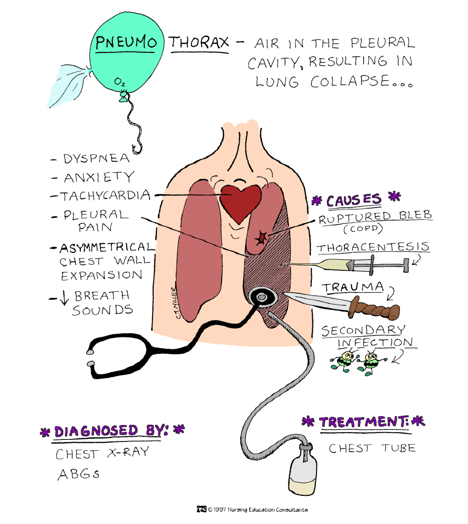
2015 Guidelines on diagnosis and treatment of primary spontaneous pneumothorax

Primary spontaneous pneumothorax (PSP) affects young healthy people with a significant recurrence rate. Recent advances in treatment have been variably implemented in clinical practice. This statement reviews the latest developments and concepts to improve clinical management and stimulate further research.
The European Respiratory Society's Scientific Committee established a multidisciplinary team of pulmonologists and surgeons to produce a comprehensive review of available scientific evidence. 
http://erj.ersjournals.com/content/46/2/321.abstract?etoc
Smoking remains the main risk factor of PSP. Routine smoking cessation is advised. More prospective data are required to better define the PSP population and incidence of recurrence. In first episodes of PSP, treatment approach is driven by symptoms rather than PSP size. The role of bullae rupture as the cause of air leakage remains unclear, implying that any treatment of PSP recurrence includes pleurodesis. Talc poudrage pleurodesis by thoracoscopy is safe, provided calibrated talc is available. Video-assisted thoracic surgery is preferred to thoracotomy as a surgical approach.
In first episodes of PSP, aspiration is required only in symptomatic patients. After a persistent or recurrent PSP, definitive treatment including pleurodesis is undertaken. Future randomised controlled trials comparing different strategies are required. 
Full text:
http://erj.ersjournals.com/content/46/2/321.abstract?etoc

Thursday, July 30, 2015

International guidelines on allergy immunotherapy 2015

Dear friends yesterday was published International guidelines on allergy immunotherapy 2015! Take a look!
Allergen immunotherapy (AIT) has been used to treat allergic disease since the early 1900s. Despite numerous clinical trials and meta-analyses proving AIT efficacious, it remains underused and is estimated to be used in less than 10% of patients with allergic rhinitis or asthma worldwide. In addition, there are large differences between regions, which are not only due to socioeconomic status. There is practically no controversy about the use of AIT in the treatment of allergic rhinitis and allergic asthma, but for atopic dermatitis or food allergy, the indications for AIT are not well defined. The elaboration of a wider consensus is of utmost importance because AIT is the only treatment that can change the course of allergic disease by preventing the development of asthma and new allergen sensitizations and by inducing allergen-specific immune tolerance. Safer and more effective AIT strategies are being continuously developed both through elaboration of new allergen preparations and adjuvants and alternate routes of administration. 
http://www.jacionline.org/article/S0091-6749%2815%2900775-7/fulltext?utm_content=buffera3d39&utm_medium=social&utm_source=facebook.com&utm_campaign=buffer
A number of guidelines, consensus documents, or both are available on both the international and national levels. The international community of allergy specialists recognizes the need to develop a comprehensive consensus report to harmonize, disseminate, and implement the best AIT practice. Consequently, the International Collaboration in Asthma, Allergy and Immunology, formed by the European Academy of Allergy and Clinical Immunology; the American Academy of Allergy, Asthma & Immunology; the American College of Allergy, Asthma & Immunology; and the World Allergy Organization, has decided to issue an international consensus on AIT.
Free Full text: 
http://www.jacionline.org/article/S0091-6749%2815%2900775-7/fulltext?utm_content=buffera3d39&utm_medium=social&utm_source=facebook.com&utm_campaign=buffer

Sunday, July 26, 2015

CHEST 2015 Guideline: Somatic Cough Syndrome (Psychogenic Cough) and Tic Cough (Habit Cough) in Adults and Children

American College of Chest Physicians (CHEST) published Guidelines on Somatic Cough Syndrome (Previously Referred to as Psychogenic Cough) and Tic Cough (Previously Referred to as Habit Cough) in Adults and Children.
Cough occurring in the absence of identified medical disease and that does not respond to medical treatment has sometimes been labeled as psychogenic cough, habit cough, or tic cough. Although these putative disorders should be differentially diagnosed from other forms of chronic cough, such as chronic refractory cough, unexplained cough, upper airway cough syndrome, vocal cord dysfunction syndrome, and cough hypersensitivity syndrome, there are currently no guidelines on how this differentiation should occur. This current guideline aims to assist the clinician when managing a patient with suspected psychogenic, habit, or tic cough.
http://journal.publications.chestnet.org/article.aspx?articleID=2250092

In children with chronic cough diagnosed with somatic cough disorder (previously referred to as psychogenic cough), we suggest non-pharmacological trials of hypnosis or suggestion therapy or combinations of reassurance, counseling, or referral to a psychologist and/or psychiatrist 
Full text:
http://journal.publications.chestnet.org/article.aspx?articleID=2250092

Thursday, July 23, 2015

New Global Initiative for Asthma 2015 strategy: a roadmap to asthma control

Today was published in ERJ: A summary of the new GINA strategy: a roadmap to asthma control!
Over the past 20 years, the Global Initiative for Asthma (GINA) has regularly published and annually updated a global strategy for asthma management and prevention that has formed the basis for many national guidelines. However, uptake of existing guidelines is poor. A major revision of the GINA report was published in 2014, and updated in 2015, reflecting an evolving understanding of heterogeneous airways disease, a broader evidence base, increasing interest in targeted treatment, and evidence about effective implementation approaches. During development of the report, the clinical utility of recommendations and strategies for their practical implementation were considered in parallel with the scientific evidence. 
http://erj.ersjournals.com/content/early/2015/07/23/13993003.00853-2015.full

This article provides a summary of key changes in the GINA report, and their rationale. The changes include a revised asthma definition; tools for assessing symptom control and risk factors for adverse outcomes; expanded indications for inhaled corticosteroid therapy; a framework for targeted treatment based on phenotype, modifiable risk factors, patient preference, and practical issues; optimisation of medication effectiveness by addressing inhaler technique and adherence; revised recommendations about written asthma action plans; diagnosis and initial treatment of the asthma−chronic obstructive pulmonary disease overlap syndrome; diagnosis in wheezing pre-school children; and updated strategies for adaptation and implementation of GINA recommendations. 

Full text of the article:
http://erj.ersjournals.com/content/early/2015/07/23/13993003.00853-2015.full