Showing posts with label American Academy of Sleep Medicine. Show all posts

Friday, March 3, 2017

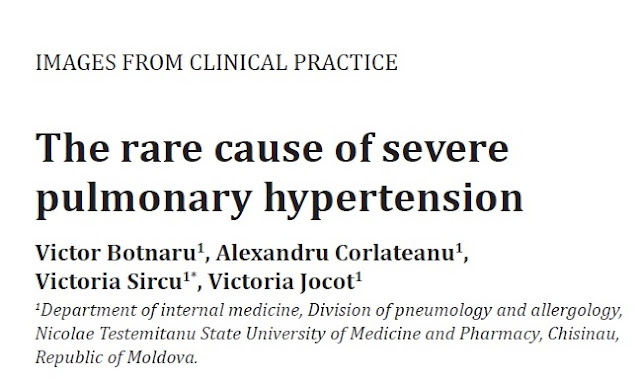
The rare cause of Severe Pulmonary Hypertension (free full text from 2017 Moldovan Journal of Health Sciences)


Female patient, aged 57, retired, non-smoking, presents dyspnea on exertion, at minimal effort, chronic severe fatigue, daytime sleepiness, insomnia, broken sleep associated with snoring and apneas, nocturia (2-3 times/night), morning headaches and xerostomia, periodic pain in the periumbilical region. 
https://www.researchgate.net/publication/314185866_The_rare_cause_of_severe_pulmonary_hypertension

From history: juvenile obesity (100 kg), hypertensive since the age of 50, presents sleep disturbances and noisy snoring for over 10 years. The physical examination reveals dry skin, mild inferior limbs edema, acrocyanosis (lips, legs), obesity with the BMI = 47 kg/m2 (m=118 kg, h=154 cm), neck girth = 43 cm, abdominal circumference = 140 cm, umbilical hernia 3x4 cm, free nasal breathing, diminished vesicular sounds, stable hemodynamics (HR= 68/min; BP= 130/80 mmHg), Mallampati score III and17 points on the Epworth Sleepiness Scale.
Chest X-ray was normal, ECG revealed signs of right ventricular strain. The EcoCG revealed slight dilation of both atria (up to 56 mm) with the left ventricle of normal dimensions and preserved ejection fraction (50%), severe right ventricle (RV) dilatation (46 mm) and severe pulmonary hypertension (pulmonary artery systolic pressure 80 mm Hg). SpO2 at rest is 95%. Spirometric and blood gazes values are as follows FEV1-81%; FVC-80%; FEV1/FVC-109%, pH 7,43; PaO2 96 mm Hg; PaCO2 44 mm Hg.
Questions:
  Considering the anamnestic data and the physical examination, which are the probable causes of pulmonary hypertension?
  What tests do you suggest for confirmation?

https://www.researchgate.net/publication/314185866_The_rare_cause_of_severe_pulmonary_hypertensionWhich treatment is the most suitable?

https://www.researchgate.net/publication/314185866_The_rare_cause_of_severe_pulmonary_hypertension
  Free full text is HERE!

Sunday, December 7, 2014

Do you have Obstructive Sleep Apnea?

Most individual symptoms and signs have limited utility in determining the likelihood of OSA, and no one sign is sufficiently precise to rule in or rule out this condition. Although the absence of snoring makes a diagnosis of OSA less likely, snoring on its own is common and does not discriminate between those with and without OSA. Thus, snoring must be interpreted in the context of other symptoms and signs. Likewise, self-reported sleepinessandmorning headaches do not help discriminate among patients with and without OSA. It is somewhat surprising that the overall impression of sleep medicine physicians of the likelihood of OSA in individual patients does not perform much better than the limited utility of individual findings. It is important to recognize that persons with normal body weight who do not snore are unlikely to have OSA, and their complaints of daytime sleepiness or fatigue should prompt an evaluation for alternative diagnoses. 

Although the evidence shows that a number of recently published multi-itemed questionnaires may help rule out OSA, they are not helpful in identifying patients affected by sleep apnea. Fortunately, it appears that an explicit combination of only a few findings, expressed as the SACS, has promise for identifying patients most likely to have OSA. Although the test is seemingly easy to use, validation at current diagnostic thresholds in more general populations by primary care clinicians would provide important evidence to justify its use in routine screening.

Wednesday, June 26, 2013

Future of sleep medicine

President of American Academy of Sleep Medicine (AASM) M. Safwan Badr speaks about the challenges and opportunities the AASM and the field of sleep medicine will face in the coming year. Dr. Badr speaks about the impact of the Affordable Care Act, the move towards an integrated care model and the AASM’s overall strategic plan
 

Saturday, March 9, 2013

World Sleep Day 2013 on Respiratory Decade and the return of daylight saving time

World Sleep Day is an annual event, intended to be a celebration of sleep and a call to action on important issues related to sleep, including medicine, education, social aspects and driving. 

This weekend marks the return of daylight saving time for most of the United States. To help ensure a smooth transition to the new time, the American Academy of Sleep Medicine (AASM) recommends that you begin to adjust your sleep schedule a few days prior to the beginning of daylight saving time.
AASM offers the following tips to help you cope with the upcoming change to daylight saving time:

• Try to go to bed 15 or 20 minutes earlier each night before the time change. This will give your body a chance to adjust.
• Begin to adjust the timing of other daily routines that are “time cues” for your body. For example, start eating dinner a little earlier each night.
• On Saturday night, set your clocks ahead one hour in the early evening. Then go to sleep at your normal bedtime.
• Try to go outside for some early morning sunlight on Sunday. The bright light will help set your “body clock,” which regulates sleep and alertness.
• Be careful when driving or operating machinery if you feel drowsy on Sunday.
• Stick to your bedtime on Sunday night to get plenty of sleep before the workweek begins on Monday.