Showing posts with label anti-smoking ads. Show all posts

Saturday, March 3, 2018

More evidences for ban of e-cigarettes: prolonged exposure might result in asthma, COPD and inflammation

A critical review outlining the toxicological profile and immunological consequences of e-cigarette use was published these days in European Respiratory Review
Knowledge of the long-term toxicological and immunological effects of e-cigarette (e-cig) aerosols remains elusive due to the relatively short existence of vaping. Therefore, we performed a systematic search of articles published in public databases and analysed the research evidence in order to provide critical information regarding e-cig safety. Electronic nicotine delivery systems (or e-cigs) are an alternative to traditional cigarettes for the delivery of nicotine and are typically filled with glycerol or propylene glycol-based solutions known as e-liquids. Though present in lower quantities, e-cig aerosols are known to contain many of the harmful chemicals found in tobacco smoke. 
http://err.ersjournals.com/content/27/147/170119
However, due to the paucity of experimental data and contradictory evidence, it is difficult to draw conclusive outcomes regarding toxicological, immunological and clinical impacts of e-cig aerosols. Excessive vaping has been reported to induce inflammatory responses including mitogen-activated protein kinase, Janus tyrosine kinase/signal transducer and activator of transcription and nuclear factor-κB signalling, similar to that induced by tobacco smoke.  
Based on recent evidence, prolonged exposure to some constituents of e-cig aerosols might result in respiratory complications such as asthma, chronic obstructive pulmonary disease and inflammation. 
Future studies are warranted that focus on establishing correlations between e-cig types, generations and e-liquid flavours and immunological and toxicological profiles to broaden our understanding about the effects of vaping.
Full text:

Tuesday, May 31, 2016

World No Tobacco Day 2016: Plain-packaging to protect our youth: “Progress made, challenges ahead”

The European Respiratory Society hosted a World No Tobacco Day event Plain-packaging to protect our youth: “Progress made, challenges ahead” in collaboration with the European Network for Smoking Prevention (ENSP) to highlight the research-backed benefits of plain packaging on tobacco products and to celebrate the countries who have led the way – hoping to encourage remaining countries to follow their lead.
The event took place at the European Parliament in Brussels on 31 May, 2016 and supports the theme announced by the World Health Organisation (WHO) for this year’s World No Tobacco Day campaign, which is: “Get ready for plain-packaging”. It is also timely alongside the introduction of plain packaging on tobacco products in the U.K, Ireland and France.

Sunday, May 29, 2016

World No Tobacco Day 31 May 2016: Get ready for plain packaging

Tobacco packaging is a mobile billboard promoting consumption of tobacco products. If you strip back the decoration, gloss and misleading elements of tobacco packaging, you are left with little more than a box of deadly, addictive products that kill approximately 6 million people a year and harm the health of many more. Plain packaging helps reveal the grim reality of tobacco products.
For World No Tobacco Day on 31 May 2016, WHO and the Secretariat of the WHO Framework Convention on Tobacco Control are calling on countries to get ready for plain (also called standardized) packaging of tobacco products. 

The aims of plain packaging are to:
  • reduce the attractiveness of tobacco products;
  • eliminate the effect of tobacco packaging as a form of advertising and promotion;
  • eliminate package design techniques that may suggest that some products are less harmful than others; and
  • increase the noticeability and effectiveness of health warnings.
The results of experimental studies, surveys and focus-group studies show that plain packaging achieves its objectives. WHO recommends that plain packaging be used as part of a comprehensive approach to tobacco control, which also includes comprehensive bans on tobacco advertising, promotion and sponsorship and other tobacco packaging and labelling measures, such as health warnings.

Saturday, May 28, 2016

World No Tobacco Day 2016: WHO study Group on tobacco Product regulation (tobreg): banning menthol in tobacco products

Menthol is a flavouring agent commonly used in cigarettes and other tobacco products. Menthol cigarettes are used more frequently by younger smokers, women and ethnic minorities, and their use facilitates both initiation and continued smoking, leading to addiction. These issues have raised global concern. 

http://apps.who.int/iris/bitstream/10665/205928/1/9789241510332_eng.pdf?ua=1

To address this public health issue, the WHO Study Group on Tobacco Product Regulation (TobReg) has prepared this advisory note on menthol, which synthesizes recent studies on the prevalence and health effects of menthol in tobacco products. It provides evidence-based conclusions and recommendations for policy-makers and regulators, including a ban on menthol (and its analogues, derivatives and precursors) in cigarettes.

Full text:

Saturday, May 31, 2014

The business of smoking

Countries in the east are increasing production and consumption of cigarettes while western countries are cutting back.


Tobacco-quitting cigarettes on World No Tobacco Day 2014

Taiwanese designer Tseng Yi Wen has conceived a series of 4 tobacco-quitting cigarettes aimed to break smoking habits. the concept behind each would make tobacco consumption significantly less, while still allowing for an occasional smoke.

Tobacco-day’ prints the date on every cigarette, reminding the smoker of how many they have consumed, and to limit the allowed number of smokes per month. 
‘could you give me a cigarette?’ is a common question often asked by smokers. yi wen has conceived a single cigarette that is sharable, to be broken into two parts. by dividing the tobacco, you help reduce the other person’s smoking amount, and your own.
 

Thursday, May 29, 2014

World No Tobacco Day 2014 is 31 May 2014

For a long time, the tobacco industry has fiercely opposed levies on tobacco products and launched intense campaigns against efforts to raise tobacco taxes, making the fight to curb tobacco use challenging. The reality is that raising taxes on tobacco products is the most effective way to reduce tobacco use, generate revenue for health programs and most importantly, save lives. That’s why the World Health Organization (WHO) is putting tobacco taxes back on the agenda for World No Tobacco Day 2014.
https://www.facebook.com/events/706491222730461/

According to WHO estimates, if all countries increased tobacco excise taxes by 50% per pack this would result in 49 million fewer smokers and 11 million lives saved. Plus, governments around the world would earn an extra $101 billion that they could put towards health and social programs.
Raising taxes on tobacco and making tobacco products more expensive is particularly effective in reducing tobacco use in developing countries, where people often do not get adequate treatment if they fall sick from illnesses associated with tobacco use like cancer.
WHO collects and analyzes data of tax prices around the world and tracks best practices. It advises governments on how best to strengthen their tax systems and raise tax rates. We know that some countries are already benefitting from increased tobacco taxes.  Turkey, for example, has steadily increased excise taxes since 2008. Within the following four years, tobacco sales had fallen by 12%. In 2008, 22 countries had tax rates sufficiently high enough to impact consumption. In 2012, that had increased to 32 countries.

Friday, January 3, 2014

Stop any type of smoking

Earlier we had very good news from USA about ban of e-cigarettes in New York. It is paradox, but bad news about smoking are also from USA: Colorado kicks off legal sales of recreational marijuana Wednesday, 1 January 2014 at state-licensed stores. 

Thursday, December 5, 2013

What Happens When A Smoker Quits

Dear Respiratory friends we are happy to present info graphic: What Happens When A Smoker Quits!


Tuesday, November 5, 2013

TWINS WHO SMOKE LOOK OLDER

Dear Respiratory friends we are presenting new evidence about effect of smoking!!!
Twins who smoke show more premature facial aging, compared to their non-smoking identical twins, reports a study in the November issue of Plastic and Reconstructive Surgery®, the official medical journal of the American Society of Plastic Surgeons (ASPS).
It is well-known that smoking is bad for you, but do you know how it affects the way you look?
Smoking causes dry skin and increases the chances of facial wrinkling. It depletes the skin of oxygen and essential nutrients.
Take a look at the pictures of these different pairs of twins and try and guess who is the smoker without looking at the captions!

The study finds significant differences in facial aging between twins with as little as five years' difference in smoking history, says a new report by ASPS Member Surgeon Dr. Bahman Guyuron, Professor and Chairman, Department of Plastic Surgery, University Hospital Case Medical and Case School of Medicine, Cleveland. The results also suggest that the effects of smoking on facial aging are most apparent in the lower two-thirds of the face.

Wednesday, October 30, 2013

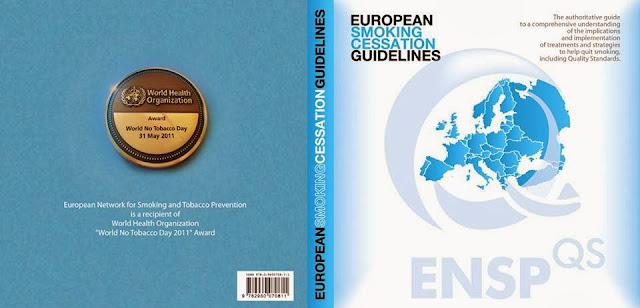
European Smoking Cessation Guidelines 2013

Dear Respiratory friends we are happy to present new Smoking Cessation Guidelines!

The European Smoking Cessation Guidelines and Quality Standards are the main output of a project undertaken by ENSP to create a coherent and reliable set of guidelines for healthcare professionals working in the field of smoking cessation. The Guidelines form a complete range of tools to support smoking cessation strategies. The work was undertaken by the Editorial Board comprising seven eminent professors and the Board of Revisers from across the entire European continent and is the first of its kind. These guidelines are in accordance with Article 14 of the Framework Convention on Tobacco Control (FCTC), which states that:
Parties should develop and disseminate comprehensive tobacco dependence treatment guidelines based on the best available scientific evidence and best practices, taking into account national circumstances and priorities. These guidelines should include two major components: (1) a national cessation strategy, to promote tobacco cessation and provide tobacco dependence treatment, aimed principally at those responsible for funding and implementing policies and programs; and (2) national treatment guidelines aimed principally at those who will develop, manage and provide cessation support to tobacco users.
http://www.ensp.org/sites/default/files/ENSP-ESCG_FINAL.pdf
This project aims to support smoking cessation activities and strengthen their impact by:
  • providing health professionals with a European template of smoking cessation guidelines and best practice;
  • providing the tobacco control community with tools for monitoring and accreditation.

Saturday, October 12, 2013

Anti-Smoking Letter to President of European Parliament about Philip Morris

Dear friends we are reproducing and supporting Letter to President of European Parliament about Philip Morris lobbying activities on the Tobacco Products Directive 

Dear President Schulz,
We are writing to express our very deep concerns regarding the attempts by the tobacco industry lobby to derail vital public health legislation currently going through the Parliament.
As you will know, the EU is currently finalising the review of Tobacco Products Directive (TPD), a crucial piece of legislation for protecting the public from tobacco (the largest preventable cause of death and disease in the world). However, in recent weeks, European news media such as The Guardian, Der Spiegel and Le Parisien have reported extensively about leaked documents which outline the lobbying strategies and activities of tobacco giant Philip Morris International to influence the European Parliament’s decision-making on the TPD. There is widespread concern that the decision to delay the plenary vote on the TPD was a result of tobacco companies like Philip Morris International and others using their economic and political power to influence MEPs. The postponement of the vote is widely believed to be part of a tobacco industry strategy to delay, weaken or even derail the TPD. The leaked documents show that no less than 233 MEPs (almost one third of the Parliament) have been met by Philip Morris International lobbyists at least once. Several MEPs were listed as having had four or five such meetings.
This large number of meetings (which have taken place behind closed doors, without any transparency such as the publication of minutes from these meetings), constitutes a serious violation of the World Health Organization Framework Convention on Tobacco Control (WHO FCTC) Article 5.3 which is geared towards safeguarding public health policy-making from tobacco industry interference. FCTC Article 5.3 recognizes the fundamental and irreconcilable conflict of interest between the tobacco industry and public health policy-making. It also recognises that the tobacco industry has, for decades, been working tirelessly to delay, block, and weaken life-saving health measures, like those enshrined in the FCTC.
FCTC Article 5.3 requires all Parties, when deciding on their public health policies with respect to tobacco control to “. . . act to protect these policies from commercial and other vested interests of the tobacco industry in accordance with national law”.
The WHO’s accompanying guidelines stipulate that decision-makers “should interact with the tobacco industry only when and to the extent strictly necessary to enable them to effectively regulate the tobacco industry and tobacco products.”
The guidelines state that “where interactions with the tobacco industry are necessary, Parties should ensure that such interactions are conducted transparently”.
We are deeply concerned about the astounding level of access to MEPs by tobacco lobbyists which has been exposed in the leaked Philip Morris International documents. As President of the European Parliament, we consider that it is your urgent responsibility to take determined action to ensure proper implementation of Article 5.3 of the FCTC, in order to assure that the Parliament protects its decision-making from tobacco lobby influence. This is crucial in order to protect public health and the interests of EU citizens in strong tobacco regulation and for the Parliament to fulfill its UN obligations.

Sunday, July 28, 2013

48 years from first health warnings on cigarette packages

27 July 1965: President Johnson signed a bill requiring cigarette makers to print health warnings on all cigarette packages about the effects of smoking. 


The landmark Surgeon General's report from 1965 on smoking and health stimulated a greatly increased concern about tobacco on the part of the American public and government policymakers and led to a broad-based anti-smoking campaign. It also motivated the tobacco industry to intensify its efforts to question the scientific evidence linking smoking and disease. The report was also responsible for the passage of the Cigarette Labeling and Advertising Act of 1965, which, among other things, mandated Surgeon General's health warnings on cigarette packages.

Sunday, November 25, 2012

Quit smoking: Italian version!!!

Today we are presenting you Smettere di fumare fumando, the movie by Italian director Gianni Pacinotti
From 40 to zero cigarettes at once. This Documentary was filmed the first ten days of tobacco abstinence. The result was a movie!!!

Friday, November 23, 2012

New Strategies of Prevention of Respiratory Diseases in Moldova

Dear Respiratory friends I would like to share with you my presentation about New Strategies of Prevention of Respiratory Diseases from National Health Forum from Moldova 23.11.2012!
It is on New program of prevention of Respiratory Disease in Moldova and study of Burden of Obstructive Lung Diseases in Moldova! Now we are looking for funding of this study! 

Saturday, November 17, 2012

Sunday Respiratory Video: LIFE IN SMOKE - UNA VITA IN FUMO

November is a Lung Cancer Awareness Month!!
Respiratory Decade is supporting all Respiratory initiative!
Today we are posting Life in Smoke - Una Vita in Fumo is a short-film created completly by our Italian friend Gianluca Fratellini. The story tells about Phil, a man like everyone else yet different, has a mother that smokes. They have an unusual experience of meeting the world of cigarettes, which changes his life, as well as the lives of others.
0

Thursday, October 18, 2012

Breaking news: Tobacco industry attacks

Today, we want to support our Respiratory friends and colleagues from 3 key well-known anti-tobacco organizations from Brussels! This night offices of European Respiratory Society (ERS), Smoke Free Partnership (SFP) and European Public Health Alliance (EPHA) were broken into and confidential data relating to the revision of the EU Tobacco Products Directive and other issues were stolen.
All organisations have offices in the same building on 49-51 Rue des Treves, Brussels (on the 2nd and 5th floors). When Police arrived, it was soon apparent that only 3 offices (from a building with over 20) had been broken into - with SFP, ERS and EPHA being the only organisations ransacked and with multiple items missing. 

We are supporting all anti-tobacco initiatives! We want to say to all  our friends that we need to continue this struggle with tobacco and tobacco industry! These cruel actions confirm that it is business, but this business becomes illegal not only by their dirty methods of promotion in low income countries, but also by their struggle with anti-smoking organizations and leading European policy makers!

We want to call everybody to continue this fight with Smoking Industry because at the moment its represents real risk for the health of mankind and for the life of the next generations!
Be strong! Smoke Free Society is a very real!    


Thursday, May 31, 2012

Today is World NO Tobacco Day 2012!!!

Tobacco is public health enemy number one. It kills six million people every year. The tobacco industry does everything it can to undermine anti-tobacco work. World Health Organization has chosen "Stop tobacco industry interference" as the theme for the 2012 World No Tobacco Day - on 31 May. Discover the subversive methods of the tobacco industry by watching the campaign video.

In Republic of Moldova we shared anti-smoking posters in many local places. Also we will organize massive distribution of questionnaires about smoking among young people!

Saturday, May 26, 2012

Real Tobacco Stories before World No Tobacco Day 2012

Everybody knows that 31 May 2012 is World No Tobacco Day!! We want to share with you short films about real people telling their tobacco stories. The stories range from inspirational to heart wrenching and portray the real day to day consequences of tobacco use.
Special thanks to Binta Jalloh!


Marcy, Charles and Sharon share their experiences with COPD and the effects it can have on someone. All three have smoked, but since quit.
Leo's father passed away due to tobacco-related cancer. He smoked for four years himself until this happened, and then he quit.


Capital Metro Transit Authority in Austin, Texas encourages it's employees to live tobacco-free.