Showing posts with label copd 2015 guidelines. Show all posts

Monday, September 28, 2015

COPD Foundation is launching COPD PRAXIS (Prevent and Reduce COPD Admissions through eXpertise and Innovation Sharing)

Dear Respiratory Friends,
Today the COPD Foundation is launching COPD PRAXIS (Prevent and Reduce COPD Admissions through eXpertise and Innovation Sharing), an initiative aimed at improving COPD care and reducing preventable hospital readmissions.
PRAXIS is a robust collaborative and multidisciplinary effort to advance the scientific knowledge around how to reduce COPD readmissions and facilitate the dissemination and implementation of best practices, tools and new ideas. Front-line clinical providers across the care continuum, those in charge of designing care delivery systems, policy makers, healthcare solutions companies and more are looking for solutions to help reduce COPD readmission rates. PRAXIS can help. - See more at: http://www.copdfoundation.org/Praxis/About-PRAXIS/Why-PRAXIS.aspx#sthash.dDVmuXYy.dpuf
http://www.copdfoundation.org/Praxis/About-PRAXIS/What-is-PRAXIS.aspx
The backbone of the project will be an interactive website containing:
  • Discussion boards and a blog to facilitate sharing of best practices;
  • A resource repository full of toolkits, articles, and promising practices related to improving COPD care and reducing readmissions;
  • A learning center where we will host live, video, and paper professional development opportunities;
  • A policy corner containing relevant policy statements and legislative news; 
  • An innovation center, where we'll keep the community up to date on promising new approaches and technology.
The site is LIVE at www.copdfoundation.org/PRAXIS
Please forward this message to colleagues who may find this information beneficial and let us know if you have any comments or questions at COPDPRAXIS@copdfoundation.org.

We look forward to seeing you there!

Sunday, September 27, 2015

The Asthma–COPD Overlap Syndrome 2015 Update

This week in NEJM was published review on asthma–COPD overlap syndrome!
Approximately 1 in 12 people worldwide are affected by asthma or chronic obstructive pulmonary disease (COPD); once regarded as two distinct disease entities, these two conditions are now recognized as heterogeneous and often overlapping conditions. The term “asthma–COPD overlap syndrome” (ACOS) has been applied to the condition in which a person has clinical features of both asthma and COPD.
http://www.nejm.org/doi/full/10.1056/NEJMra1411863
Full text for free download:

Tuesday, September 22, 2015

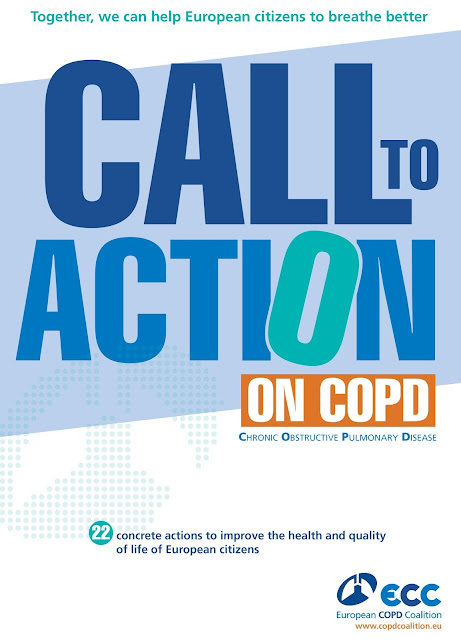
European COPD Coalition Call to Action - updated 2015

The European COPD Coalition calls for action and support from the EU decision makers to help fight the disease and reduce its financial, social and psychological impact  
Health policy decision- makers must support patients, their families, carers and the entire society impacted by the burden of the disease, by creating a framework programme that will be aimed at eliminating avoidable COPD incidence and premature death.
https://docs.google.com/forms/d/10XjvMgzd1kISPNXgm0i5VMFu8lofBjk5CDVhVzBiygA/viewform

The European COPD Coalition’s Call to Action  seeks political impetus to put in place the right structure addressing all aspects of COPD. This framework should aim to improve the health and quality of life of European citizens, including persons at risk of, or affected by, COPD. Based on the common European values of universal healthcare, access to good quality care, equity and solidarity, and encouraging innovation, the COPD framework  should encompass health promotion, disease prevention, medical and psychological support, and the social and environmental aspects of the disease.
ECC Call to Action promotes 22 concrete measures to be put in place or supported by the European Union, in full cooperation with Member States, regulating bodies and stakeholders.

Monday, August 24, 2015

New Journal: COPD Research and Practice

Dear friends we are happy to present you new Respiratory Journal: COPD Research and Practice.
COPD Research and Practice publishes basic and clinical research and cutting edge reviews related to chronic obstructive pulmonary disease (COPD). The journal aims to facilitate discussion and dissemination of knowledge to help translate new ideas from bench to bedside by encouraging international and interdisciplinary collaboration.
http://www.copdrp.com/

Editorial from Editor in Chief Professor Mario Cazzola from the University of Rome Tor Vergata, Rome, Italy:
Chronic obstructive pulmonary disease (COPD) is now the fourth leading cause of death globally, and the World Health Organization (WHO) has predicted that it will become the third most common cause of death in the world by 2030 [1]. In developed countries, current information estimates a prevalence of 8 % to 10 % among adults 40 years of age and older, whereas in developing countries, prevalence varies significantly among countries and is difficult to quote [2].
It is estimated that more than 210 million people have the disease worldwide [3]. Concerning a large number of subjects, COPD generates important health and social costs. However, although COPD is one of the most common chronic diseases and has a high health and social impact, it is still poorly recognized among the general public and also clinicians. Consequently, there is a major and urgent need to better understand this complex disease.
Free full text:

Sunday, July 19, 2015

COPD 2015 Guidelines: The 2015 update of the Global Initiative for Chronic Obstructive Lung Disease

In 2011, the Global Initiative for Chronic Obstructive Lung Disease (GOLD) released a consensus report, Global Strategy for the Diagnosis, Management, and Prevention of COPD. It recommended a major revision in the management strategy for COPD that was presented in the original 2001 document. Updated reports released in January 2013, January 2014, and January 2015 are based on scientific literature published since the completion of the 2011 document but maintain the same treatment paradigm. Assessment of COPD is based on the patient’s level of symptoms, future risk of exacerbations, the severity of the spirometric abnormality, and the identification of comorbidities. The 2015 update adds an Appendix on Asthma COPD Overlap Syndrome, material prepared jointly by the GOLD and GINA Science Committees.
www.goldcopd.org/uploads/users/files/GOLD_Report_2015_Apr2.pdf
 
The GOLD 2015 report is presented as a “strategy document” for health care professionals to use as a tool to implement effective management programs based on available health care systems. The quadrant management strategy tool is designed to be used in any clinical setting; it draws together a measure of the impact of the patient’s symptoms and an assessment of the patient’s risk of having a serious adverse health event in the future. Many studies have assessed the utility/relevance of this new tool. Evidence will continue to be evaluated by the GOLD committees and management strategy recommendations modified as required.
GOLD has been fortunate to have a network of international distinguished health professionals from multiple disciplines. Many of these experts have initiated investigations of the causes and prevalence of COPD in their countries, and have developed innovative approaches for the dissemination and implementation of the GOLD management strategy. The GOLD initiative will continue to work with National Leaders and other interested health care professionals to bring COPD to the attention of governments, public health officials, health care workers, and the general public to raise awareness of the burden of COPD and to develop programs for early detection, prevention and approaches to management.
The GOLD 2015 report: direct link
www.goldcopd.org/uploads/users/files/GOLD_Report_2015_Apr2.pdf

Saturday, July 18, 2015

Millions of smokers have undiagnosed COPD

More than half of smokers with normal spirometry had some form of respiratory-related impairment associated with COPD, Dr. Elizabeth A. Regan and the Genetic Epidemiology of COPD (COPDGene) investigators reported in JAMA Internal Medicine.
The findings imply that up to 35 million current and former smokers older than age 55 years in the United States may have some form of respiratory-related impairment associated with COPD that has gone undiagnosed with standard spirometry, the researchers wrote (JAMA Internal Med. 2015 June 22 (doi:10.1001/jamainternmed.2015.2735). 

They found that 55% of current and former smokers older than age 55 years in the study who did not meet the spirometric criteria for COPD (GOLD [Global Initiative for Chronic Obstructive Lung Disease] 0 score) had significant respiratory disease. Their conclusion was based on seven metrics: chronic bronchitis (seen in 12.6% of the GOLD 0 participants), history of severe respiratory exacerbations (seen in 4.3%), dyspnea score of at least 2 (seen in 23.5%), quantitative emphysema exceeding 5% (seen in 9.8%), quantitative gas trapping exceeding 20%, (seen in 12.2%), St. George’s Respiratory Questionnaire (SGRQ) total score exceeding 25 (seen in 26%), and a 6-minute walk distance of less than 350 m (seen in 15.4%).
In 108 never smokers, none had chronic bronchitis or respiratory exacerbations, 3.7% had dyspnea, 8.3% had quantitative emphysema exceeding 5%, 10.2% had quantitative gas trapping exceeding 20%, 3.7% had SGRQ scores above 25, and 3.7% had a 6-minute walk distance of less than 350 m.
Dr. Regan of National Jewish Health and the University of Colorado, Denver, and her associates gathered data from 21 sites across the United States regarding 8,872 current or former smokers who were between the ages of 45 and 80 years and were classified using GOLD spirometric criteria based on postbronchodilator spirometry: 4,388 had a GOLD 0 score, defined as a normal postbronchodilator ratio of FEV1 to forced vital capacity exceeding 0.7 and an FEV1 percentage of at least 80% predicted; 794 patients had a GOLD 1 score, defined as mild COPD; and 3,690 had a GOLD 2-4 score, defined as moderate to severe COPD.
Compared with 108 never smokers, the GOLD 0 group had a worse quality of life score (mean SGRQ total score 17.6 for GOLD 0 and 7 for never smokers) and a lower 6-minute walk distance (447 m vs. 493 m). In a subset of 300 patients in the GOLD 0 group whose CT scans were visually scored, 42% (127) had evidence of emphysema or airway thickening. In a subset of 100 never smokers, 10% had evidence of emphysema or airway thickening.
Current guidelines do not include treating smokers with normal spirometry, but physicians recognize the role of medication in treating symptoms and effective treatments need to be determined for GOLD 0 patients, the researchers said. Respiratory medications were being prescribed to 20% of the GOLD 0 participants in COPDGene who had at least one impairment, yet these patients reported more symptoms.

Thursday, April 23, 2015

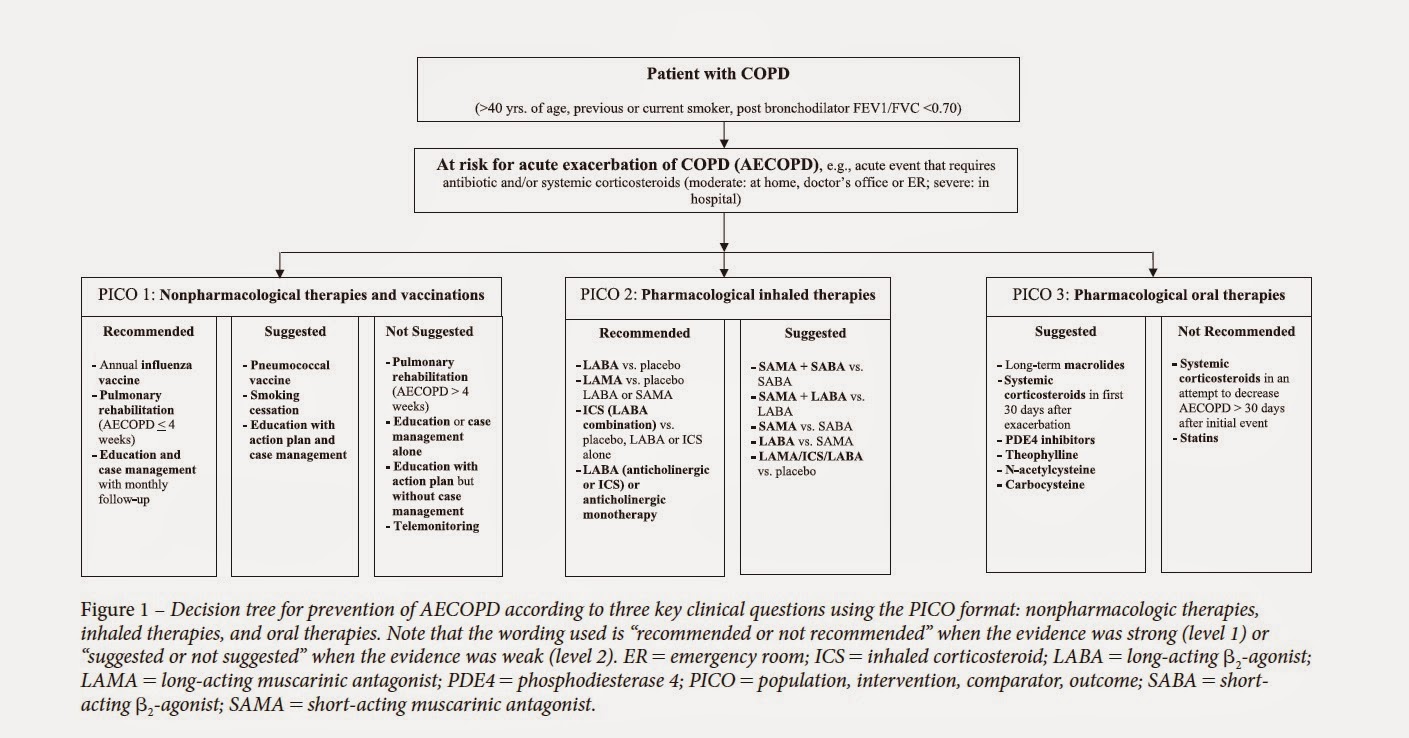
Prevention of Acute Exacerbation of COPD: American College of Chest Physicians and Canadian Thoracic Society Guideline 2015 (free download)

Respiratory decade is happy to present you new COPD Guidelines 2015!
The overall objective of this CHEST and CTS joint evidence-based guideline (AECOPD Guideline) was to create a practical, clinically useful document describing the current state of knowledge regarding the prevention of AECOPD according to major categories of prevention therapies. We accomplished this by using recognized document evaluation tools to assess and choose the most appropriate studies and evidence to extract meaningful data and to grade the level of evidence supporting the recommendations in a balanced and unbiased fashion. The AECOPD Guideline is unique not only for its topic but also for the first-in-kind partnership between two of the largest thoracic societies in North America. The CHEST Guidelines Oversight Committee in partnership with the CTS COPD Clinical Assembly launched this project with the objective that a systematic review and critical evaluation of the published literature by clinical experts and researchers in the field of COPD would lead to a series of recommendations to assist clinicians in their management of the patient with COPD. This guideline is unique because a group of interdisciplinary clinicians who have special expertise in COPD clinical research and care led the development of the guideline process with the assistance of methodologists.
Full text of the guidelines:
http://journal.publications.chestnet.org/article.aspx?articleID=1918413

http://journal.publications.chestnet.org/data/Journals/CHEST/933666/chest_147_4_883.pdf

Monday, April 20, 2015

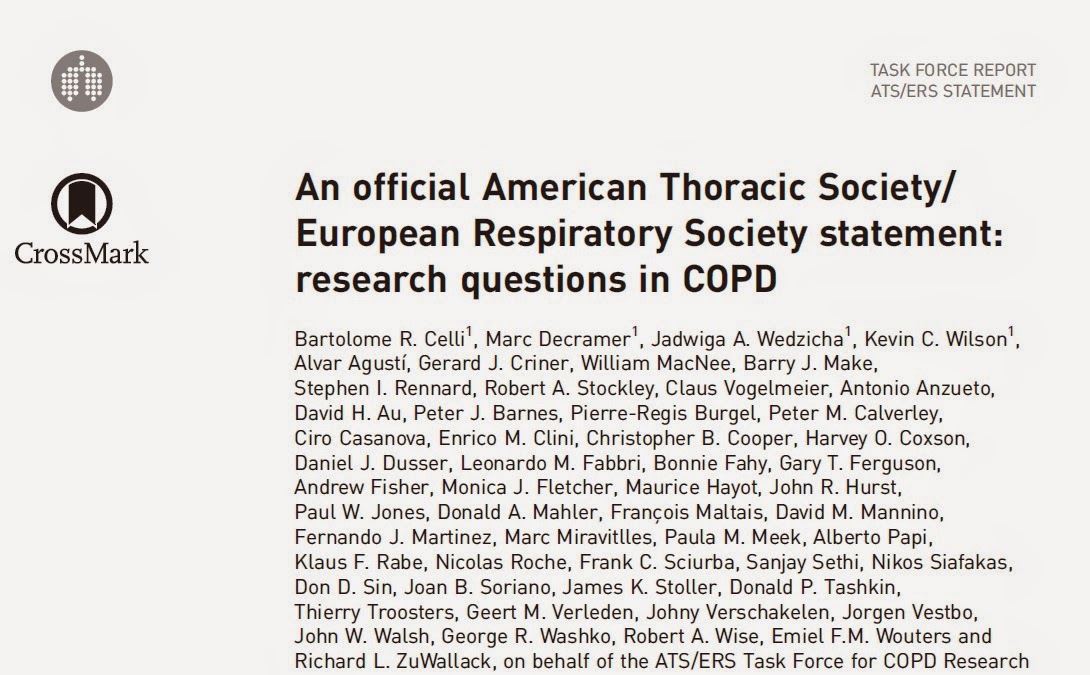
An official American Thoracic Society/European Respiratory Society statement: research questions in COPD 2015 UPDATE

Chronic obstructive pulmonary disease (COPD) is a leading cause of morbidity, mortality, and resource use worldwide. The goal of this official American Thoracic Society (ATS)/European Respiratory Society (ERS) research statement is to describe evidence related to diagnosis, assessment and management; identify gaps in knowledge; and make recommendations for future research. It is not intended to provide clinical practice recommendations on COPD diagnosis and management.
Clinicians, researchers, and patient advocates with expertise in COPD were invited to participate. A literature search of Medline was performed, and studies deemed relevant were selected. The search was not a systematic review of the evidence. Existing evidence was appraised and summarised, and then salient knowledge gaps were identified.
Recommendations for research that addresses important gaps in the evidence in all areas of COPD were formulated via discussion and consensus. 
http://erj.ersjournals.com/content/45/4/879.full.pdf+html

Great strides have been made in the diagnosis, assessment and management of COPD, as well as understanding its pathogenesis. Despite this, many important questions remain unanswered. This ATS/ERS research statement highlights the types of research that leading clinicians, researchers, and patient advocates believe will have the greatest impact on patient-centred outcomes.