Showing posts with label copd 2016 guidelines. Show all posts

Saturday, November 19, 2016

#BreatheBoldly for World COPD Day 2016!

Respiratory Decade is supporting #BreatheBoldly campaign for increasing awareness for COPD!
We challenge you to post a straw selfie on social media to raise awareness and show empathy for the 300 million people with #COPD, because sadly, COPD can feel like breathing through a straw. So, #BreatheBoldly, because even with COPD, there’s always a way to make life better. For more information visit: http://philips.to/2geuzma
http://www.usa.philips.com/healthcare/sites/copd-care-and-solutions/all-about-copd/world-copd-day


Saturday, October 22, 2016

Current Controversies in the Pharmacological Treatment of Chronic Obstructive Pulmonary Disease (article from Blue Journal 2016)

Clinical phenotyping is currently used to guide pharmacological treatment decisions in chronic obstructive pulmonary disease (COPD), a personalized approach to care. Precision medicine integrates biological (endotype) and clinical (phenotype) information for a more individualized approach to pharmacotherapy, to maximize the benefit versus risk ratio. Biomarkers can be used to identify endotypes. To evolve toward precision medicine in COPD, the most appropriate biomarkers and clinical characteristics that reliably predict treatment responses need to be identified. 
http://www.atsjournals.org/doi/abs/10.1164/rccm.201606-1179PP#.WAuvWMlESUl
FEV1 is a marker of COPD severity and has historically been used to guide pharmacotherapy choices. However, we now understand that the trajectory of FEV1 change, as an indicator of disease activity, is more important than a single FEV1 measurement. There is a need to develop biomarkers of disease activity to enable a more targeted and individualized approach to pharmacotherapy. Recent clinical trials testing commonly used COPD treatments have provided new information that is likely to influence pharmacological treatment decisions both at initial presentation and at follow up. In this Perspective, we consider the impact of recent clinical trials on current COPD treatment recommendations. We also focus on the movement toward precision medicine and propose how this field needs to evolve in terms of using clinical characteristics and biomarkers to identify the most appropriate patients for a given pharmacological treatment.
Read More: 

Friday, September 23, 2016

Chronic Respiratory Symptoms with Normal Spirometry: A Reliable Clinical Entity? (Blue journal 2016)

Dear friends we are happy to present you new interesting review on new clinical entity: chronic respiratory symptoms in persons with normal spirometry!
The 2001 Global Initiative for Chronic Obstructive Lung Disease (GOLD) Report defined five stages of spirometric severity (post-bronchodilator FEV1/FVC≥0.7): 0, and 1 (mild) to 4 (very severe). GOLD Stage 0 was defined by chronic cough and sputum production or chronic mucus hypersecretion (CMH) alone with preserved FEV1/FVC. Subsequently, GOLD 0 was discarded as further evidence of COPD development in subjects with GOLD 0 was not more likely to develop. 
http://www.atsjournals.org/doi/abs/10.1164/rccm.201607-1376PP?journalCode=ajrccm#.V-VbNDVESUk
When expanding symptomatic burden in GOLD 0 to include other chronic respiratory symptoms, such as dyspnea, wheeze, poor quality of life, limited physical activity, and ‘COPD exacerbations-like’ events needing health resources, symptomatic smokers with normal FEV1 resulted in larger risk of death. We review the evidence supporting a relationship between an increased symptom burden, long-term FEV1 decline and development of COPD. We also address the evidence for the presence of respiratory symptoms with normal FEV1 in smokers as a potential clinical entity. This subset of symptomatic patients encompasses a compelling category of smokers with normal spirometry but increased risk for poor outcomes. What exactly these symptomatic patients with intact FEV1 represent remains unclear. Whether they exemplify smoking-induced just a broadening of respiratory abnormalities or a distinct clinical entity that precedes the development of COPD or both remains unknown. Other aims, such as providing information on pathogenesis and future areas of research, are just as vital. What ultimately prevails however is the importance of the public health message to the frightening presence of chronic respiratory symptoms in the whole population.
Read More: 

Friday, September 16, 2016

Predicting Health-Related Quality of Life in Patients with Chronic Obstructive Pulmonary Disease: The Impact of Age (article from Respiration)

Dear Friends, we are happy to present you our new article published online yesterday in Respiration!
Background: Chronic obstructive pulmonary disease (COPD) is a major cause of morbidity in the elderly population. COPD leads to a reduced health-related quality of life (HRQL), but the factors which contribute to this are not well understood. A better understanding of the factors which determine HRQL should lead to an improved care for such patients. Objectives: The purpose of this study was to investigate possible age-related differences in HRQL in a population of patients with a similar severity of obstruction. 
https://www.karger.com/Article/Abstract/448625
Methods: A total of 180 consecutive COPD patients were enrolled into the study. We analyzed spirometric data, BODE index and its components, and comorbidities were assessed by the Charlson index. HRQL was assessed by the Clinical COPD Questionnaire (CCQ) and St. George's Respiratory Questionnaire (SGRQ). Results: The cohort consisted of 93 ‘younger' patients (mean age 54.8 ± 3.1 years) and 87 older patients (mean age 73.1 ± 5.5 years). Patients in both groups had a similar severity of obstruction: FEV1 (% from predicted) was 39.9 ± 13.2% in the elderly group compared to 41.7 ± 11.7% in the younger group (p > 0.05). The forward stepwise regression analysis shows that the BODE index, the Charlson index, and the rate of exacerbations are important predictors of deterioration of HRQL in elderly COPD patients, which explains 29% of the total SGRQ score. In the younger COPD patients, the coefficient of determination R2 was 0.27, but the predictors were the BODE index and the rate of exacerbations. Conclusions: The BODE index, the Charlson index, and the rate of exacerbations were found to be the major determinants of HRQL in elderly COPD patients, while in younger COPD patients, the BODE index and the rate of exacerbations were influential factors.
Full text:
Researchgate:

Sunday, September 11, 2016

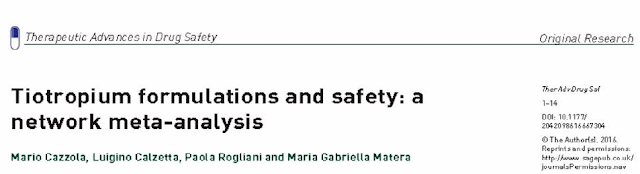
Tiotropium formulations and safety: a network meta-analysis (paper from Therapeutic Advances in Drug Safety)

Dear friends, its new paper on safety of tiotropium from Therapeutic Advances in Drug Safety by great Italian team!
Tiotropium is now delivered via two different inhaler devices: the original Handihaler 18 μg once daily, which uses a powder formulation; and the newer Respimat Soft Mist Inhaler (SMI) 5 μg once daily. It has been questioned whether the two devices can be assumed to have the same safety profile, although the TIOSPIR trial showed that tiotropium when administered via Respimat SMI 5 μg is not less safe than Handihaler 18 μg. Therefore, we have carried out a safety evaluation of tiotropium Handihaler 18 µg versus tiotropium Respimat SMI 5 µg and 2.5 µg, via systematic review and network meta-analysis of the currently available clinical evidence. The results of our meta-analysis with an extremely large number of patients analysed demonstrate that the safety profile of tiotropium HandiHaler is generally superior to that of tiotropium Respimat SMI, although no statistical difference was detected between these two devices. However, the SUCRA analysis favoured tiotropium Respimat SMI with regards to serious adverse events (AEs). We do not believe that using Respimat SMI rather that HandiHaler exposes patients to higher risks of real AEs. 
http://taw.sagepub.com/content/early/2016/09/06/2042098616667304.abstract
Rather, we believe that there may be a different cardiovascular (CV) response to muscarinic receptors blockage in individual patients. Therefore, it will be essential to make all possible efforts to proactively identify patients at increased risk of CV AEs when treated with tiotropium or another antimuscarinic drug. 
Full text:

Saturday, August 20, 2016

Systematic Review of Errors in Inhaler Use: Has Patient Technique Improved Over Time? (Chest 2016 free full text)

Background  Problems with the use of inhalers by patients were noted shortly after the launch of the metered-dose inhaler (MDI) and persist today. We aimed to assess the most common errors in inhaler use over the past 40 years in patients treated with MDIs or dry powder inhalers (DPIs).
http://journal.publications.chestnet.org/article.aspx?articleid=2514047&resultClick=3

Methods  A systematic search for articles reporting direct observation of inhaler technique by trained personnel covered the period from 1975 to 2014. Outcomes were the nature and frequencies of the three most common errors; the percentage of patients demonstrating correct, acceptable, or poor technique; and variations in these outcomes over these 40 years and when partitioned into years 1 to 20 and years 21 to 40. Analyses were conducted in accordance with recommendations from Preferred Reporting Items for Systematic Reviews and Meta-Analyses and Strengthening the Reporting of Observational Studies in Epidemiology.
Results  Data were extracted from 144 articles reporting on a total number of 54,354 subjects performing 59,584 observed tests of technique. The most frequent MDI errors were in coordination (45%; 95% CI, 41%-49%), speed and/or depth of inspiration (44%; 40%-47%), and no postinhalation breath-hold (46%; 42%-49%). Frequent DPI errors were incorrect preparation in 29% (26%-33%), no full expiration before inhalation in 46% (42%-50%), and no postinhalation breath-hold in 37% (33%-40%). The overall prevalence of correct technique was 31% (28%-35%); of acceptable, 41% (36%-47%); and of poor, 31% (27%-36%). There were no significant differences between the first and second 20-year periods of scrutiny.
Conclusions  Incorrect inhaler technique is unacceptably frequent and has not improved over the past 40 years, pointing to an urgent need for new approaches to education and drug delivery.
Read more:
http://journal.publications.chestnet.org/article.aspx?articleid=2514047&resultClick=3

Friday, August 19, 2016

Survival after Endobronchial Valve Placement for Emphysema: A 10-Year Follow-up Study (article from American Journal of Respiratory and Critical Care Medicine)

We are happy to present you A 10-Year Follow-up Study of Survival after Endobronchial Valve Placement for Emphysema recently published in American Journal of Respiratory and Critical Care Medicine! This is one of the first long term follow up studies of Endobronchial Valves in Emphysema.
There is no effective therapy for advanced emphysema at present. Hence, to find novel therapeutic methods is needed. In the past decade, the new technology of bronchoscopic lung volume reduction with endobronchial valves (EBV) has been applied to clinical. Concerns of the less invasive bronchoscopic techniques to treat emphysema to achieve the similar beneficial effects to LVRS have been developed. Bronchoscopic lung volume reduction with EBV are one-way blocking devices that stop entry of air into the most affected emphysematous zone during inspiration while allowing it to escape during expiration in order to induce lobar atelectasis.
http://www.atsjournals.org/doi/abs/10.1164/rccm.201604-0852LE?url_ver=Z39.88-2003&rfr_id=ori:rid:crossref.org&rfr_dat=cr_pub%3dpubmed#.V7fwoqKbeUl
There are published several randomized controlled trials suggesting the role of EBV in patients with severe emphysema. Some non-controlled studies also demonstrated clinical improvements in lung volumes, health status and exercise tolerance. 


Sunday, July 3, 2016

Pocket Guide to COPD Diagnosis, Management, and Prevention – 2016 (Link for free download)

Pocket Guide has been developed from the Global Strategy for the Diagnosis, Management, and Prevention of COPD (2016 Update). Technical discussions of COPD and COPD management, evidence levels, and specific citations from the scientific literature are included in that source document.
https://www.facebook.com/worldcopdday/photos/a.431789760263749.1073741826.116682571774471/914253928683994/?type=3&theater

Sunday, June 12, 2016

Global Strategy for Diagnosis, Management, and Prevention of COPD GOLD 2016 reports now available for free download

In 2011, the Global Initiative for Chronic Obstructive Lung Disease (GOLD) released a consensus report, Global Strategy for the Diagnosis, Management, and Prevention of COPD. It recommended a major revision in the management strategy for COPD that was presented in the original 2001 document. Updated reports released in January 2013, January 2014, January 2015, and December 2015 are based on scientific literature published since the completion of the 2011 document but maintain the same treatment paradigm. Assessment of COPD is based on the patient’s level of symptoms, future risk of exacerbations, the severity of the spirometric abnormality, and the identification of comorbidities. The January 2015 update added an Appendix on Asthma COPD Overlap Syndrome, material prepared jointly by the GOLD and GINA Science Committees.
https://www.facebook.com/worldcopdday/

The GOLD report is presented as a “strategy document” for health care professionals to use as a tool to implement effective management programs based on available health care systems. The quadrant management strategy tool is designed to be used in any clinical setting; it draws together a measure of the impact of the patient’s symptoms and an assessment of the patient’s risk of having a serious adverse health event in the future. Many studies have assessed the utility/relevance of this new tool. Evidence will continue to be evaluated by the GOLD committees and management strategy recommendations modified as required.
GOLD has been fortunate to have a network of international distinguished health professionals from multiple disciplines. Many of these experts have initiated investigations of the causes and prevalence of COPD in their countries, and have developed innovative approaches for the dissemination and implementation of the GOLD management strategy. The GOLD initiative will continue to work with National Leaders and other interested health care professionals to bring COPD to the attention of governments, public health officials, health care workers, and the general public to raise awareness of the burden of COPD and to develop programs for early detection, prevention and approaches to management.

Marc Decramer, MD
Chair, GOLD Board of Directors
Professor of Medicine
CEO University Hospital
University of Leuven, Leuven, Belgium


Claus Vogelmeier, MD
Chair, GOLD Science Committee
Director, Internal Medicine Clinic
University of Giessen and Marburg,
School of Medicine
Standort Marburg Baldingerstrasse
D-35043 Marburg, Germany


Official facebook page of the Global Initiative for Chronic Obstructive Lung Disease (GOLD):
https://www.facebook.com/worldcopdday/

Saturday, June 4, 2016

Management of chronic obstructive pulmonary disease beyond the lungs (Lancet 2016 article)

Chronic obstructive pulmonary disease (COPD) is an umbrella term that covers many clinical subtypes with clearly different pulmonary and extra-pulmonary characteristics, but with persistent airflow limitation in common. This insight has led to the development of a more personalised approach in bronchodilator therapy, prevention of exacerbations, and advanced treatments (such as non-invasive ventilation and lung volume reduction techniques). However, systemic manifestations and comorbidities of COPD also contribute to different clinical phenotypes and warrant an individualised approach as part of integrated disease management. Alterations in bodyweight and composition, from cachexia to obesity, demand specific management. Psychological symptoms are highly prevalent, and thorough diagnosis and treatment are necessary. Moreover, prevention of exacerbations requires interventions beyond the lungs, including treatment of gastro-oesophageal reflux disease, reduction of cardiovascular risks, and management of dyspnoea and anxiety. In this Review, we discuss the management of COPD beyond the respiratory system and propose treatment strategies on the basis of the latest research and best practices.
http://www.thelancet.com/journals/lanres/article/PIIS2213-2600%2816%2900097-7/abstract
full text:

Wednesday, May 25, 2016

Update in Chronic Obstructive Pulmonary Disease 2015 from American Journal of Respiratory and Critical Care Medicine

The morbidity and mortality of chronic obstructive pulmonary disease (COPD) continues in an uninterrupted fashion; current treatment options are limited, and there is no cure. Failure to diagnose COPD early, poor correlation of airflow obstruction with the extent and type of structural impairment, the number of comorbid conditions, and the lack of an adequate animal model for COPD account for our current inability to transform COPD treatment. Fortunately the tide is beginning to turn. 
http://www.atsjournals.org/doi/abs/10.1164/rccm.201602-0213UP#.V0XZ8OTyuUk
The medical research community has recognized these problems and has embarked on multiple paths of scientific inquiry to understand COPD pathogenesis, the clinical phenotypes, and treatments that are truly novel by using compounds that inhibit pathways of lung injury and aberrant responses of repair. The following are examples of the research work conducted on COPD in 2015 that attempt to address many of the questions that need to be answered to achieve the common goal of not only improving the care of patients with COPD but also curing them of this devastating disease.
Read More: 

Friday, May 20, 2016

A Systematic Review With Meta-Analysis of Dual Bronchodilation With LAMA/LABA for the Treatment of Stable COPD (2016 Chest full text)

Background  The wide availability of long-acting muscarinic antagonist (LAMA)/long-acting β2-agonist (LABA) fixed-dose combinations (FDCs) in the absence of head-to-head comparative pragmatic trials makes it difficult to choose which combination should be used. Therefore, we carried out a systematic review with meta-analysis that incorporated the data from trials lasting at least 3 months to evaluate the effectiveness of LAMA/LABA FDCs for COPD treatment.

Methods  Randomized controlled trials were identified by searching different databases of published and unpublished trials. We aimed to assess the influence of LAMA/LABA combinations on trough FEV1, transitional dyspnea index, St. George's Respiratory Questionnaire, and cardiac safety vs monocomponents.
Results  Fourteen papers and one congress abstract with 23,168 patients with COPD (combinations, n = 10,328; monocomponents, n = 12,840) were included in this study. Our results showed that all LAMA/LABA combinations were always more effective than the LAMA or LABA alone in terms of the improvement in trough FEV1. Although there was not significant difference among LAMA/LABA combinations, we identified a gradient of effectiveness among the currently available LAMA/LABA FDCs. LAMA/LABA combinations also improved both transitional dyspnea index and St. George's Respiratory Questionnaire scores, but did not increase the cardiovascular risk when compared with monocomponents.
Conclusions  The gradient of effectiveness emerging from this meta-analysis is merely a weak indicator of possible differences between the various LAMA/LABA FDCs. Only direct comparisons will document if a specific LAMA/LABA FDC is better than the other. In the meanwhile, we believe it is only proper to consider that dual bronchodilation is better than a LAMA or a LABA alone, regardless of the drugs used.
full text from Chest:
http://journal.publications.chestnet.org/article.aspx?articleid=2499555&resultClick=3

Tuesday, May 17, 2016

The discovery of roflumilast for the treatment of chronic obstructive pulmonary disease (2016 Expert Opinion on Drug Discovery)

Dear Respiratory friends, we are happy to present you exciting story of  discovery of roflumilast for the treatment of COPD by great Italian team: Mario Cazzola, Luigino Calzetta, Paola Rogliani & Maria Gabriella Matera.
Introduction: Cyclic adenosine monophosphate (cAMP) phosphodiesterase (PDE)4 is an intracellular target that can be exploited to the treat chronic obstructive pulmonary disease (COPD), given that it is expressed in all inflammatory cells implicated in this inflammatory airways disease. At the present time, roflumilast is the only PDE4 inhibitor that has received regulatory approval for use in patients with COPD.
Areas covered: The preclinical, clinical and post-marketing development of roflumilast is described. Furthermore, a critical analysis of the clinical data and positioning of this drug is undertaken in this review
http://www.tandfonline.com/doi/abs/10.1080/17460441.2016.1184642
 
Expert opinion: The identification of a subset of COPD patients, namely those suffering from severe airflow obstruction with symptoms of chronic cough and sputum and a history of previous exacerbations, as a specific target for roflumilast with the goal of reducing exacerbations, was entirely casual because the delineation of a “chronic bronchitis” responder group was clearly a post-hoc finding. However, it was useful to design prospective clinical trials that demonstrated reduced exacerbations in this specific subset of patients towards whom roflumilast therapy is now targeted. However, these pivotal trials still do not provide more accurate identification of the type of exacerbation to be treated by roflumilast. The identification of the right biological COPD exacerbation phenotype and/or the right clinical COPD phenotype are the only means that could justify the use of roflumilast as a first line anti-inflammatory therapeutic approach.
full text:

Sunday, May 15, 2016

Indacaterol–Glycopyrronium versus Salmeterol–Fluticasone for COPD (full text article from NEJM 2016)

Dear Respiratory Friends great news come from NEJM about dual bronchodilators in COPD!
Most guidelines recommend either a long-acting beta-agonist (LABA) plus an inhaled glucocorticoid or a long-acting muscarinic antagonist (LAMA) as the first-choice treatment for patients with chronic obstructive pulmonary disease (COPD) who have a high risk of exacerbations. The role of treatment with a LABA–LAMA regimen in these patients is unclear.
http://www.nejm.org/doi/full/10.1056/NEJMoa1516385#t=article


Methods

We conducted a 52-week, randomized, double-blind, double-dummy, noninferiority trial. Patients who had COPD with a history of at least one exacerbation during the previous year were randomly assigned to receive, by inhalation, either the LABA indacaterol (110 μg) plus the LAMA glycopyrronium (50 μg) once daily or the LABA salmeterol (50 μg) plus the inhaled glucocorticoid fluticasone (500 μg) twice daily. The primary outcome was the annual rate of all COPD exacerbations.

Results

 
full text from todays NEJM:

Friday, April 8, 2016

From smoking to COPD – current approaches in 2016 (full text from Pneumologia)

Our new article was published in ‪#‎Pneumologia‬: from ‪#‎smoking‬ to ‪#‎COPD‬: current approaches
Chronic obstructive pulmonary disease (COPD) remains a leading cause of death all over the world. Even though it is the most intensely studied disease induced by cigarette smoking there are still incomplete researches concerning its pathophysiology and treatment. So far it has been determined the deleterious effects of the secreted molecules diversity and some feasible therapies for their diminution. 
https://www.researchgate.net/publication/299775809_From_smoking_to_COPD_-_current_approaches?ev=prf_pub
According to current studies more relevance gains the possible autoimmune origin of COPD and the epigenetic modifications. The idea of autoimmunity in smoking induced COPD began to be speculated with the discovery of autoantibodies in patient's serum, but there are some studies who consider antibody complexes that reside in the lung tissue as more relevant for future research. By developing the autoimmune aspect of COPD it will become possible to select more precise treatment strategies. The importance of epigenetic changes in this field might be appreciated starting with the fact of an existing connection between epigenetic modifications induced by maternal smoking and latter COPD development. This explains the tendency toward different drugs capable of restoring these transformations such as deacetylation agents expected also to prevent steroid resistance. Nevertheless smoking cessation remains as the indispensable approach for COPD treatment and prevention.
Keywords: COPD, smoking, epigenetic changes 
Full text:

Monday, February 1, 2016

Treatable traits: toward precision medicine of chronic airway diseases (ERJ paper)

Dear friends, this is new article on new approaches in asthma and COPD from todays European Respiratory Journal! 
Asthma and chronic obstructive pulmonary disease (COPD) are two prevalent chronic airway diseases that have a high personal and social impact. They likely represent a continuum of different diseases that may share biological mechanisms (i.e. endotypes), and present similar clinical, functional, imaging and/or biological features that can be observed (i.e. phenotypes) which require individualised treatment. Precision medicine is defined as “treatments targeted to the needs of individual patients on the basis of genetic, biomarker, phenotypic, or psychosocial characteristics that distinguish a given patient from other patients with similar clinical presentations”. In this Perspective, we propose a precision medicine strategy for chronic airway diseases in general, and asthma and COPD in particular.
http://erj.ersjournals.com/content/47/2/410

Full text:

Saturday, January 30, 2016

Defining the Asthma-COPD Overlap Syndrome in a COPD Cohort (Chest article)

Asthma-COPD overlap syndrome is very contradictory topic in Respiratory medicine!
Background  Asthma-COPD overlap syndrome (ACOS) has been recently described by international guidelines. A stepwise approach to diagnosis using usual features of both diseases is recommended although its clinical application is difficult.
http://journal.publications.chestnet.org/article.aspx?articleid=2430458&resultClick=3

Methods  To identify patients with ACOS, a cohort of well-characterized patients with COPD and up to 1 year of follow-up was analyzed. We evaluated the presence of specific characteristics associated with asthma in this COPD cohort, divided into major criteria (bronchodilator test > 400 mL and 15% and past medical history of asthma) and minor criteria (blood eosinophils > 5%, IgE > 100 IU/mL, or two separate bronchodilator tests > 200 mL and 12%). We defined ACOS by the presence of one major criterion or two minor criteria. Baseline characteristics, health status (COPD Assessment Test [CAT]), BMI, airflow obstruction, dyspnea, and exercise capacity (BODE) index, rate of exacerbations, and mortality up to 1 year of follow-up were compared between patients with and without criteria for ACOS.
Results  Of 831 patients with COPD included,125 (15%) fulfilled the criteria for ACOS, and 98.4% of them sustained these criteria after 1 year. Patients with ACOS were predominantly male (81.6%), with symptomatic mild to moderate disease (67%), who were receiving inhaled corticosteroids (63.2%). There were no significant differences in baseline characteristics, and only survival was worse in patients with non-ACOS COPD after 1 year of follow-up (P < .05).
Conclusions  The proposed ACOS criteria are present in 15% of a cohort of patients with COPD and these patients show better 1-year prognosis than clinically similar patients with COPD with no ACOS criteria.
Full text:
http://journal.publications.chestnet.org/article.aspx?articleid=2430458&resultClick=3

Sunday, January 3, 2016

Global Strategy for Diagnosis, Management, and Prevention of COPD - 2016

In 2011, the Global Initiative for Chronic Obstructive Lung Disease (GOLD) released a consensus report, Global Strategy for the Diagnosis, Management, and Prevention of COPD. It recommended a major revision in the management strategy for COPD that was presented in the original 2001 document. Updated reports released in January 2013, January 2014, January 2015, and December 2015 are based on scientific literature published since the completion of the 2011 document but maintain the same treatment paradigm. Assessment of COPD is based on the patient’s level of symptoms, future risk of exacerbations, the severity of the spirometric abnormality, and the identification of comorbidities. The January 2015 update added an Appendix on Asthma COPD Overlap Syndrome, material prepared jointly by the GOLD and GINA Science Committees.
www.goldcopd.org/uploads/users/files/GOLD_Report%202016.pdf
The GOLD report is presented as a “strategy document” for health care professionals to use as a tool to implement effective management programs based on available health care systems. The quadrant management strategy tool is designed to be used in any clinical setting; it draws together a measure of the impact of the patient’s symptoms and an assessment of the patient’s risk of having a serious adverse health event in the future. Many studies have assessed the utility/relevance of this new tool. Evidence will continue to be evaluated by the GOLD committees and management strategy recommendations modified as required.
GOLD has been fortunate to have a network of international distinguished health professionals from multiple disciplines. Many of these experts have initiated investigations of the causes and prevalence of COPD in their countries, and have developed innovative approaches for the dissemination and implementation of the GOLD management strategy. The GOLD initiative will continue to work with National Leaders and other interested health care professionals to bring COPD to the attention of governments, public health officials, health care workers, and the general public to raise awareness of the burden of COPD and to develop programs for early detection, prevention and approaches to management.
Marc Decramer, MD
Chair, GOLD Board of Directors
Professor of Medicine
CEO University Hospital
University of Leuven, Leuven, Belgium
Claus Vogelmeier, MD
Chair, GOLD Science Committee
Director, Internal Medicine Clinic
University of Giessen and Marburg,
School of Medicine
Standort Marburg Baldingerstrasse
D-35043 Marburg, Germany

Link for free download: