Sunday, December 11, 2016

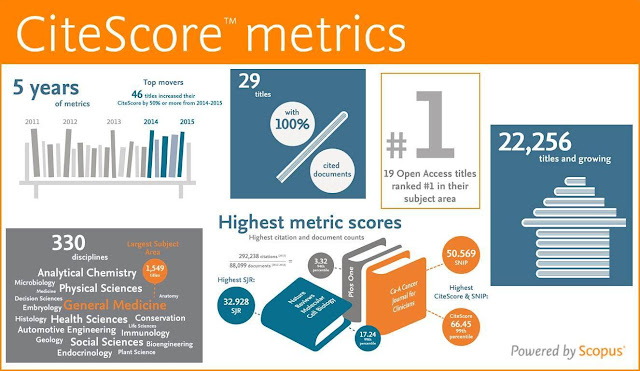
Elsevier’s CiteScore metrics provide comprehensive, transparent, current insights into journal impact

Impact plays an important part in understanding the performance of a journal over time and making decisions about its future. It is impossible to get a true picture of impact using a single metric alone, so a basket of metrics is needed to support informed decisions.
Today Elsevier is launching CiteScore metrics: a new standard that gives a more comprehensive, transparent and current view of a journal’s impact that will help you guide your journal more effectively in the future.
CiteScore metrics are part of the Scopus basket of journal metrics that includes SNIP (Source Normalized Impact per Paper), SJR (SCImago Journal Rank), citation- and document- counts and percentage cited. The integration of these metrics into Scopus provides insights into the citation impact of more than 22,220 titles.
CiteScore metrics from Scopus is a comprehensive, current and free metrics for serial titles in Scopus.

https://journalmetrics.scopus.com/?DGCID=Social_Twitter_post2&sf45681268=1

Search or filter below to find the sources of interest and see the new metrics. Report using these annual metrics and track the 2016 metrics via the links to each title’s Scopus source details page.

Be sure to use qualitative as well as the below quantitative inputs when presenting your research impact, and always use more than one metric for the quantitative part.
Use from now CiteScore metrics online:

Wednesday, December 7, 2016

New issue of Current Respiratory Medicine Reviews (Volume 12 - Number 3) online

Dear Friends was published new issue of Current Respiratory Medicine Reviews (Volume 12 - Number 3)!
http://benthamscience.com/journals/current-respiratory-medicine-reviews/#top
Table of Contents  (For viewing abstracts please visit this link)

Meet Our Editorial Board Member Pp. 183-184
Russell W. Steele
[Download PDF]
Editorial
Editorial: "COPD: More than a Moving Target!" Pp. 185-185
Alexandru Corlateanu and Joseph Varon
[Download PDF]
Review Article
Molecular Based Drug Targets for Idiopathic Pulmonary Fibrosis Pp. 186-207
Beatriz Ballester, Javier Milara, Esteban Morcillo and Julio Cortijo
[Abstract] [Purchase Article]
Review Article
Investigations of Malignant Mesothelioma Pp. 208-214
Jack A. Kastelik, Mahmoud Loubani, Gerard Avery, Anthony G. Arnold and Jaymin Morjaria
[Abstract] [Purchase Article]
Review Article
Understanding the Immune and Inflammatory Response to Rhinoviruses: Recent Advances with Relevance to Asthma Pp. 215-224
Kuhan Kunarajah, Olga Pena and John W. Upham
[Abstract] [Open Access Plus]
Research Article
Exercise-Induced Pulmonary Edema in Athletes Pp. 225-231
Serghei Covantev, Alexandru Corlateanu, Victor Botnaru and Joseph Varon
[Abstract] [Purchase Article]
Review Article
The Role of Systemic Treatment and Radiotherapy in Malignant Mesothelioma Pp. 232-240
Michael Lind, Rachael Barton, Andrzej Wieczorek, Mahmoud Loubani and Jack A. Kastelik
[Abstract] [Purchase Article]
Case Studies
Pleural Involvement Due to Metastatic Melanoma: A Rare Complication and Literature Review Pp. 241-245
Misael Avalos, Salim Surani and Joseph Varon
[Abstract] [Purchase Article]

Saturday, December 3, 2016

Start a clean air revolution!

On December 2nd, Paris, Madrid, Mexico City and Athens pledged to remove diesel vehicles from their roads by 2025. This unprecedented action will have a lasting impact on improving air quality and protecting the health of residents. 
The mayors of Paris, Mexico City, Madrid and Athens say they are implementing the ban to improve air quality.
They say they will give incentives for alternative vehicle use and promote walking and cycling.
The commitments were made in Mexico at a biennial meeting of city leaders.
The use of diesel in transport has come under increasing scrutiny in recent years, as concerns about its impact on air quality have grown. The World Health Organization (WHO) says that around three million deaths every year are linked to exposure to outdoor air pollution.
The respiratory tract is the portal of entry of air pollutants, and thus the lung is the first organ affected. The range of respiratory diseases that can be caused by air pollution exposure is large. Studies on the health impacts of air pollution differentiate between acute and chronic effects. The acute effects of pollution may be apparent within hours or days of exposure, but other health effects of air pollution result from long-term exposure, leading to chronic disease.

Wednesday, November 23, 2016

Prevalence and burden of comorbidities in Chronic Obstructive Pulmonary Disease (FREE FULL TEXT ARTICLE from RESPIRATORY INVESTIGATION 2016)

We are happy to present you article Prevalence and burden of comorbidities in Chronic Obstructive Pulmonary Disease from RESPIRATORY INVESTIGATION 2016 which was published today!

http://www.sciencedirect.com/science/article/pii/S2212534516300703
The classical definition of Chronic Obstructive Pulmonary Disease (COPD) as a lung condition characterized by irreversible airway obstruction is outdated. The systemic involvement in patients with COPD, as well as the interactions between COPD and its comorbidities, justify the description of chronic systemic inflammatory syndrome. The pathogenesis of COPD is closely linked with aging, as well as with cardiovascular, endocrine, musculoskeletal, renal, and gastrointestinal pathologies, decreasing the quality of life of patients with COPD and, furthermore, complicating the management of the disease. The most frequently described comorbidities include skeletal muscle wasting, cachexia (loss of fat-free mass), lung cancer (small cell or non-small cell), pulmonary hypertension, ischemic heart disease, hyperlipidemia, congestive heart failure, normocytic anemia, diabetes, metabolic syndrome, osteoporosis, obstructive sleep apnea, depression, and arthritis. These complex interactions are based on chronic low-grade systemic inflammation, chronic hypoxia, and multiple common predisposing factors, and are currently under intense research. 
http://www.sciencedirect.com/science/article/pii/S2212534516300703
This review article is an overview of the comorbidities of COPD, as well as their interaction and influence on mutual disease progression, prognosis, and quality of life.
Free full text:

Saturday, November 19, 2016

#BreatheBoldly for World COPD Day 2016!

Respiratory Decade is supporting #BreatheBoldly campaign for increasing awareness for COPD!
We challenge you to post a straw selfie on social media to raise awareness and show empathy for the 300 million people with #COPD, because sadly, COPD can feel like breathing through a straw. So, #BreatheBoldly, because even with COPD, there’s always a way to make life better. For more information visit: http://philips.to/2geuzma
http://www.usa.philips.com/healthcare/sites/copd-care-and-solutions/all-about-copd/world-copd-day


Thursday, November 17, 2016

New Global Strategy for Diagnosis, Management, and Prevention of COPD - 2017 Update (free full text link)

The Global Initiative for Chronic Obstructive Lung Disease (GOLD) works with health care professionals and public health officials around the world to raise awareness of Chronic Obstructive Pulmonary Disease (COPD) and to improve prevention and treatment of this lung disease.
http://goldcopd.org/download/326/Through the development of evidence-based strategy documents for COPD management, and events such as the annual celebration of World COPD Day, GOLD is working to improve the lives of people with COPD in every corner of the globe.
The GOLD report is presented as a “strategy document” for health care professionals to use as a tool to implement effective management programs based on available health care systems.  GOLD has been fortunate to have a network of international distinguished health professionals from multiple disciplines. Many of these experts have initiated investigations of the causes and prevalence of COPD in their countries, and have developed innovative approaches for the dissemination and implementation of the GOLD management strategy. The GOLD initiative will continue to work with National Leaders and other interested health care professionals to bring COPD to the attention of governments, public health officials, health care workers, and the general public to raise awareness of the burden of COPD and to develop programs for early detection, prevention and approaches to management. 
Full text: