Showing posts with label Asthma 2014 guidelines. Show all posts

Saturday, December 20, 2014

COPD and Asthma are remaining neglected at the global level

The forthcoming post-Millennium Development Goals era will bring about new challenges in global health. Low- and middle-income countries will have to contend with a dual burden of infectious and non-communicable diseases (NCDs). Some of these NCDs, such as neoplasms, COPD, cardiovascular diseases and diabetes, cause much health loss worldwide and are already widely recognized as doing so.
The chronic nature of asthma and COPD requires continuous care and reliable access to affordable medications. These conditions have been set out by the Global Initiative for Asthma (GINA) and Global Initiative for Chronic Obstructive Lung Disease (GOLD) together with the need to prevent exacerbations with the use, in the first instance, of inhaled drugs. However the costs and availability of inhaled drugs are very variable and there is a tendency for these to cost more in low income countries.

Sunday, August 3, 2014

AIRWAYS-ICPs - Integrated care pathways for airway diseases: new perspective

Dear Respiratory friends please read about new perspectives with AIRWAYS-ICPs project!
Chronic respiratory diseases are major non-communicable diseases. Asthma and allergic diseases occur throughout the life cycle and can begin during pregnancy and childhood. In Europe, they affect 30 million children and adults under 45 years of age. Chronic obstructive pulmonary disease (COPD) has an estimated annual death rate of over 4 million people globally. Among the European Union (EU) member states, asthma accounted for an average of 53 hospital admissions per 100 000 population in 2009, and the average COPD-related admission rate was 184. The annual direct and indirect costs in the 28 EU countries due to COPD or asthma are estimated at €48 billion and €34 billion, respectively. Chronic respiratory diseases affect active and healthy ageing. Asthma in children or adults is a common risk factor for COPD in adults. 

The aim of AIRWAYS-ICPs is to improve healthy life years and to reduce burden (emergency visits, avoidable hospitalisations, disability and costs) while improving quality of life worldwide, and, in the longer term, to reduce disease incidence by new and innovative prevention strategies.
AIRWAYS-ICPs has a clear strategic relevance with regard to the EU Health Strategy as it will bring added value to the existing public health knowledge:
  • To propose a common framework for chronic respiratory disease (and for comorbidities) ICPs for the entire EU which can then be expanded to other regions (e.g. the Commonwealth of Independent States) and which will allow comparability and trans-national initiatives.
  • To help risk stratification in chronic respiratory disease patients, using a common strategy.
  • To develop cost-effective policies, in particular strengthening those on smoking and environment exposure.
  • To have a significant implication on the health of citizens in the short term (reduction of morbidity, improvement of education in children and of work in adults) and in the long term (healthy ageing).
  • To propose a common simulation tool for the entire EU in order to assist physicians in the segmentation of patients and in the choice of pathways. 
    http://erj.ersjournals.com/content/44/2/304.extract?etoc

    More information was published last week in European Respiratory Journal: 
    J. Bousquet et al.
    Integrated care pathways for airway diseases (AIRWAYS-ICPs) Eur Respir J 2014 44:304-323; published ahead of print 2014, doi:10.1183/09031936.00014614
    http://erj.ersjournals.com/content/44/2/304.extract?etoc

Monday, May 5, 2014

2014 International Guidelines on Asthma: The Global Initiative for Asthma launched on World Asthma Day 2014

The Global Initiative for Asthma (GINA) today is launching a new edition of its Global Strategy for Asthma Management and Prevention, a comprehensive and practical resource about one of the most common chronic lung diseases worldwide. The first major revision of this document in eight years builds on a strong existing evidence base,and provides an integrated approach to diagnosing, assessing and managing asthma that spans all ages and can be adapted to national and local needs. The report is presented as an easy to use resource for managing problems that health professionals encounter every day across a wide range of health systems. 
http://www.ginasthma.org/local/uploads/files/GINA_Report_2014.pdf
 
“The new report reflects the latest science concerning the nature of asthma, an expanding interest in individualized health care, and greater awareness of the need for clinical recommendations to be feasible for implementation in clinical practice,” says Dr. Helen Reddel, Clinical Associate Professor at the Woolcock Institute of Medical Research in Sydney, Australia. “This is a real time of transition in our understanding of chronic airways disease and how to manage it to improve outcomes for the patient. ” As Chair of the GINA Science Committee, Dr. Reddel led the international group of asthma experts that produced the new report. The report is being released on World Asthma Day, an annual awareness raising event held the first Tuesday in May and organized by GINA. Dozens of events around the world will take place today around the theme “You Can Control Your Asthma.”

Thursday, May 1, 2014

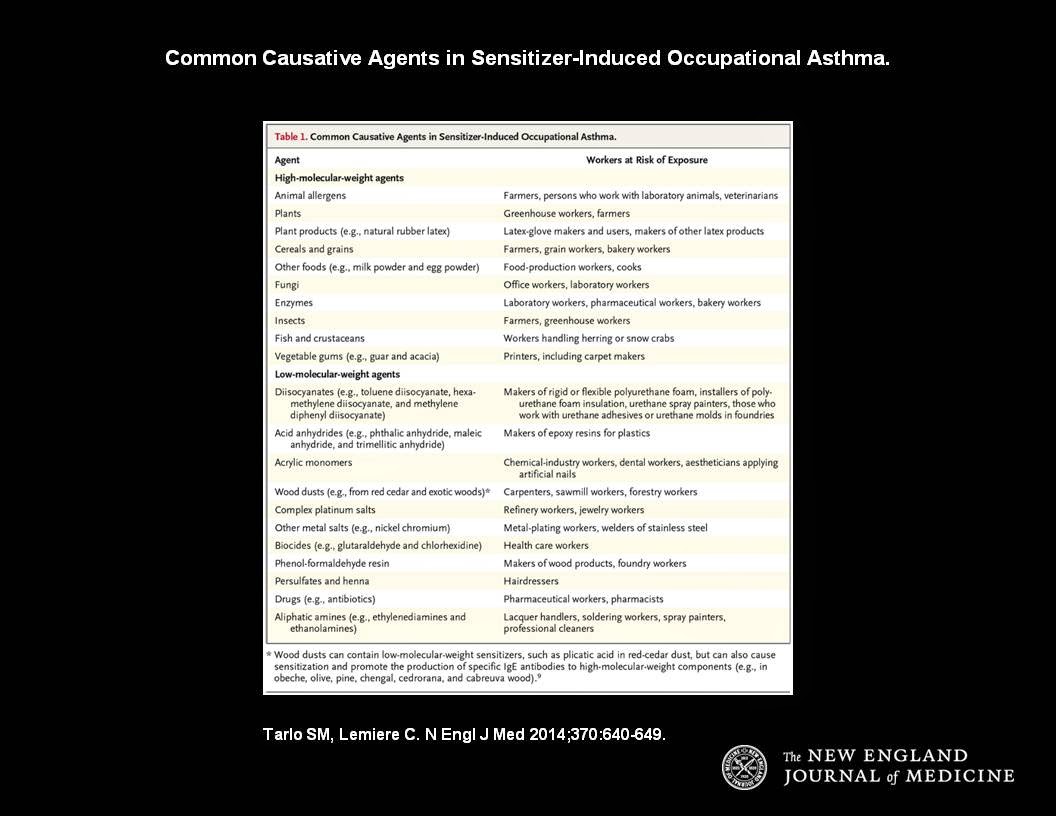
Occupational Asthma

Today we are presenting new review on Occupational Asthma from NEJM!
Asthma is common in the general population, including those in the workforce.Work exposures can cause or exacerbate asthma and can also be associated with asthma variants as well as symptoms that mimic asthma (e.g., the irritable larynx syndrome). In addition, even non–work-related asthma can affect the ability to work. This review focuses on current data about occupational asthma, defined as asthma due to conditions attributable to work exposures and not to causes outside the workplace.
http://www.nejm.org/doi/full/10.1056/NEJMra1301758

Occupational AsthmaSusan M. Tarlo, M.B., B.S., and Catherine Lemiere, M.D.N Engl J Med 2014; 370:640-649 February 13, 2014 DOI: 10.1056/NEJMra1301758

Sunday, April 27, 2014

You Can Control Your Asthma on World Asthma Day 2014

World Asthma Day is organized by the Global Initiative for Asthma (GINA) in collaboration with health care groups and asthma educators to raise awareness about asthma and improve asthma care throughout the world
Each year GINA chooses a theme and organizes preparation and distribution of World Asthma Day materials and resources. World Asthma Day activities are organized in each country by health care professionals, educators, and members of the public who want to help reduce the burden of asthma.
 
The first World Asthma Day, in 1998, was celebrated in more than 35 countries in conjunction with the first World Asthma Meeting held in Barcelona, Spain. Participation has increased with each World Asthma Day held since then, and the day has become one of the world's most important asthma awareness and education events.
https://www.facebook.com/events/582588928506007/
World Asthma Day 2014 will take place on Tuesday, May 6, 2014. The theme will be "You Can Control Your Asthma," continuing the emphasis on asthma control highlighted in past WAD events. The sub-theme, "It's Time to Control Asthma" will also be continued this year, with activity organizers encouraged to adapt the "It's Time to..." statement in ways relevant to their individual events. On World Asthma Day 2014 GINA will release a new, extensively revised version of the Global Strategy for Asthma Management and Prevention

Saturday, February 8, 2014

2014 Guidelines on Severe Asthma

Dear friends I am happy to share with you new Guidelines on Severe Asthma which was published in European Respiratory Journal last week!

Severe or therapy-resistant asthma is increasingly recognised as a major unmet need in Respiratory medicine at the global level. A Task Force, supported by the European Respiratory Society and American Thoracic Society, reviewed the definition and provided recommendations and guidelines on the evaluation and treatment of severe asthma in children and adults. 

http://erj.ersjournals.com/content/43/2/343.full#sec-67

It is hoped that the current emerging understanding of the immunopathobiology of severe asthma, of biological agents and of emerging inflammatory and molecular phenotypes will generate and lead to safe and effective biomarker-driven approaches to the therapy of severe asthma. 

Kian Fan Chung, Sally E. Wenzel, Jan L. Brozek, Andrew Bush, Mario Castro, Peter J. Sterk, Ian M. Adcock, Eric D. Bateman, Elisabeth H. Bel, Eugene R. Bleecker, Louis-Philippe Boulet, Christopher Brightling, Pascal Chanez, Sven-Erik Dahlen, Ratko Djukanovic, Urs Frey, Mina Gaga, Peter Gibson, Qutayba Hamid, Nizar N. Jajour, Thais Mauad, Ronald L. Sorkness, and W. Gerald Teague
International ERS/ATS guidelines on definition, evaluation and treatment of severe asthma Eur Respir J 2014 43:343-373; published ahead of print 2013, doi:10.1183/09031936.00202013

Saturday, February 1, 2014

Janus Look in Pulmonology: COPD-Asthma overlap syndrome

In ancient Roman religion, Janus (his name in Greek is 'Ιανός - Ianós) is the god of beginnings and transitions, thence also of gates, doors, passages, endings and time. He is usually depicted as having two faces, since he looks to the future and to the past. The Romans named the month of January (Ianuarius) in his honor.
An overlap syndrome is a disease in which a patient presents with symptoms of two or more diseases. That is why Janus can be associated with overlap syndrome.

http://jctm.mums.ac.ir/?_action=articleInfo&article=2190&vol=394

Multiple epidemiological studies demonstrate that in persons with obstructive airway disease, as many as half or more may have overlapping of asthma and COPD. The term Asthma COPD overlap syndrome (ACOS) was recognized and is appearing for the first time in GOLD 2014, but without clear definition and therapeutic options. A COPD-Asthma overlap syndrome is defined as an airflow obstruction that is not completely reversible, accompanied by symptoms and signs of increased obstruction reversibility. For the clinical identification of overlap syndrome COPD-Asthma Spanish guidelines proposed six diagnostic criteria. The major criteria include very positive bronchodilator test [increase in forced expiratory volume in one second (FEV1) ≥15% and ≥400 ml], eosinophilia in sputum, and personal history of asthma. The minor criteria include high total IgE, personal history of atopy and positive bronchodilator test (increase in FEV1 ≥12% and ≥200 ml) on two or more occasions. The overlap syndrome COPD-Asthma is associated with enhanced response to inhaled corticosteroids due to the predominance of eosinophilic bronchial inflammation.The future clinical studies and multicenter clinical trials should lead to the investigation of disease mechanisms and simultaneous development of the novel treatment.
New review article on this Hot Respiratory topic just published in Journal of Cardio-Thoracic Medicine and its free for download.