Showing posts with label world asthma day. Show all posts

Tuesday, May 2, 2017

World Asthma Day 2017: read article on Asthma research in Europe from ERJ (Free full text)

Asthma is highly prevalent, often starting in infancy and persisting throughout life, and is associated with high morbidity and burden. It is a major global health challenge with growing impact, affecting more than 300 million people worldwide and at least 10% of all Europeans. Furthermore, it is the most prevalent long-term condition in children. Approximately 5–10% of asthma cases are so severe that current treatments do not work, and over five million people in the European Union (EU) fall into this category.
http://erj.ersjournals.com/content/49/5/1602294
People with asthma live at risk of life-threatening asthma attacks, leading to at least 500 000 hospitalisations worldwide each year. A European study estimated that unscheduled care and rescue medication accounted for 47% of the total cost-per-patient in infants, 45% in children and 56% in adults. This results in high socio-economic impact, estimated at more than €70 billion annually. This includes the costs of direct primary and hospital healthcare (estimated to be close to €20 billion per annum), costs due to lost productivity (€14 billion), and the monetised value of disability-adjusted life-years (DALYs) lost (over €38 billion). Close to 1 million DALYs are lost due to asthma in Europe every year.
Despite the fact that the direct and indirect costs of asthma are substantial and continue to rise, asthma remains under-prioritised in the EU research agenda. Only 0.5% of the Seventh Framework Programme (FP7) health research budget was devoted to asthma and chronic obstructive pulmonary disease (COPD) (€30 million). In comparison, some 5.4 times this amount (over €163 million) was spent on cardiovascular conditions and some 20.6 times (over €618 million) on brain research.
Asthma, with its high global prevalence and an associated multi-billion global market for treatments, plus its historical underfunding and the demand for new treatments and diagnostics, represents an enormous opportunity to drive substantial economic growth. This paper sets out how the EU may capitalise on this via investment in research with high commercial potential that can radically improve the EUs research agenda and public health.
Free full text:

Tuesday, May 3, 2016

Asthma 2016 Guidelines on World Asthma Day 2016: The 2016 update of the Global Strategy for Asthma Management and Prevention

World Asthma Day is a big event celebrated all over the world by the people to increase the awareness among public worldwide about the precautions and preventions of the asthma. This event is annually organized on international level by the GINA (Global Initiative for Asthma) in order to increase the asthma awareness all around the world. It is celebrated on annual basis at 1st Tuesday of the May month. World Asthma Day celebration was first started celebrating in the year 1998 by the GINA in more than 35 countries after its first “World Asthma Meeting” in the Barcelona, Spain.
http://ginasthma.org/2016-gina-report-global-strategy-for-asthma-management-and-prevention/
The 2016 update of the Global Strategy for Asthma Management and Prevention incorporates new scientific information about asthma based on a review of recent scientific literature by an international panel of experts on the GINA Science Committee. This comprehensive and practical resource about one of the most common chronic lung diseases worldwide contains extensive citations from the scientific literature and forms the basis for other GINA documents and programs.
Link for free download of the 2016 update of the Global Strategy for Asthma Management and Prevention:

Thursday, May 1, 2014

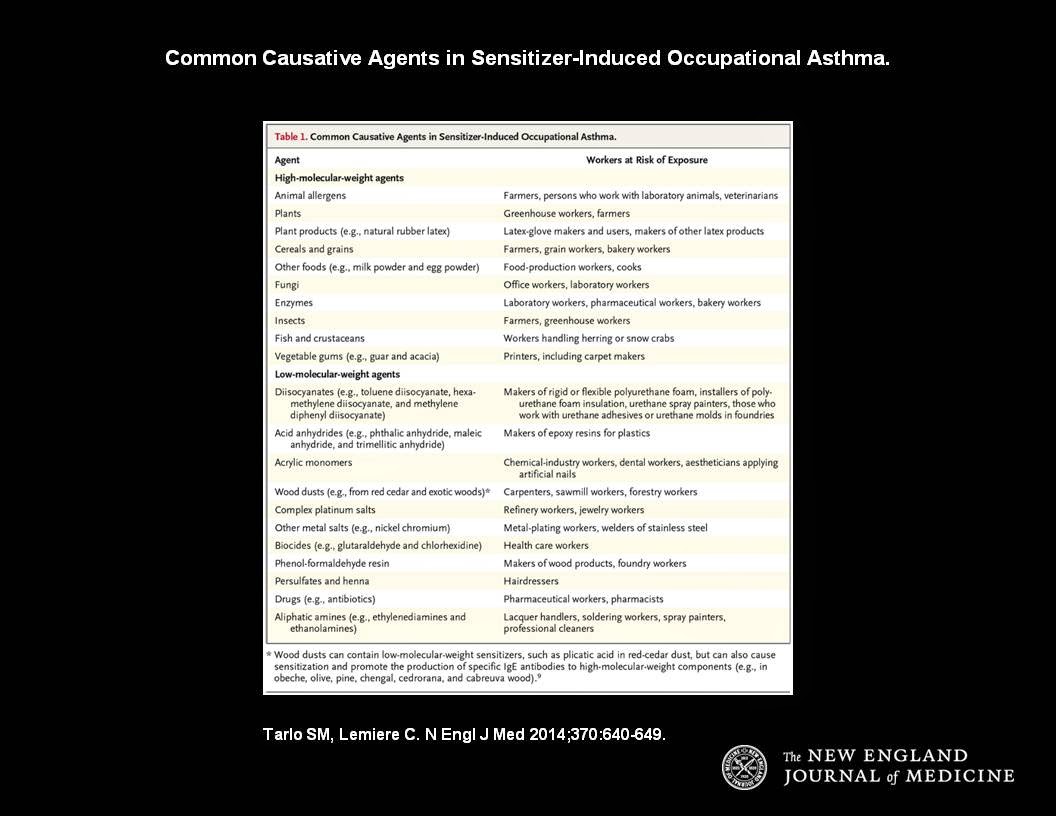
Occupational Asthma

Today we are presenting new review on Occupational Asthma from NEJM!
Asthma is common in the general population, including those in the workforce.Work exposures can cause or exacerbate asthma and can also be associated with asthma variants as well as symptoms that mimic asthma (e.g., the irritable larynx syndrome). In addition, even non–work-related asthma can affect the ability to work. This review focuses on current data about occupational asthma, defined as asthma due to conditions attributable to work exposures and not to causes outside the workplace.
http://www.nejm.org/doi/full/10.1056/NEJMra1301758

Occupational AsthmaSusan M. Tarlo, M.B., B.S., and Catherine Lemiere, M.D.N Engl J Med 2014; 370:640-649 February 13, 2014 DOI: 10.1056/NEJMra1301758

Sunday, April 27, 2014

You Can Control Your Asthma on World Asthma Day 2014

World Asthma Day is organized by the Global Initiative for Asthma (GINA) in collaboration with health care groups and asthma educators to raise awareness about asthma and improve asthma care throughout the world
Each year GINA chooses a theme and organizes preparation and distribution of World Asthma Day materials and resources. World Asthma Day activities are organized in each country by health care professionals, educators, and members of the public who want to help reduce the burden of asthma.
 
The first World Asthma Day, in 1998, was celebrated in more than 35 countries in conjunction with the first World Asthma Meeting held in Barcelona, Spain. Participation has increased with each World Asthma Day held since then, and the day has become one of the world's most important asthma awareness and education events.
https://www.facebook.com/events/582588928506007/
World Asthma Day 2014 will take place on Tuesday, May 6, 2014. The theme will be "You Can Control Your Asthma," continuing the emphasis on asthma control highlighted in past WAD events. The sub-theme, "It's Time to Control Asthma" will also be continued this year, with activity organizers encouraged to adapt the "It's Time to..." statement in ways relevant to their individual events. On World Asthma Day 2014 GINA will release a new, extensively revised version of the Global Strategy for Asthma Management and Prevention

Sunday, May 5, 2013

You Can Control Your Asthma on World Asthma Day 2013


World Asthma Day 2013, organized and sponsored by the Global Initiative for Asthma (GINA), will be held on May 7, 2013 as a partnership between health care groups and asthma educators to raise awareness about asthma and improve asthma care throughout the world.
The theme of World Asthma Day 2013 will be “You Can Control Your Asthma.” This year’s event continues the focus on this positive theme established over the past several years, and is consistent with the emphasis on asthma control set out in the latest versions of the GINA documents.

The event will also will also introduce a sub-theme, "It's Time to Control Asthma." Activity organizers around the world are encouraged to complete the sentence, "It's Time to..." as relevant to their event and target audience.

Asthma control is the goal of treatment and can be achieved in the vast majority of asthma patients with proper management.  A person’s asthma is under control when he or she has:
  • No (or minimal) asthma symptoms. 
  • No waking at night due to asthma.
  • No (or minimal) need to use “reliever” medication.
  • The ability to do normal physical activity and exercise.
  • Normal (or near-normal) lung function test results (PEF and FEV1).
  • No (or very infrequent) asthma attacks.

A strategy for achieving and maintaining asthma control is set out in the GINA Global Strategy for Asthma Management and Prevention.  The strategy requires four interrelated components of therapy:

·        Develop patient/doctor partnership.
·        Identify and reduce exposure to risk factors.
·        Assess, treat, and monitor asthma.
·        Manage asthma exacerbations.

Under this strategy, asthma is treated in a stepwise manner to achieve and maintain control of the disease.  Medication is increased—“stepped up”—when asthma is not controlled, and gradually stepped down once good control is achieved and maintained for a period of time.

World Asthma Day 2013 activities, many of which will be aimed at identifying and addressing opportunities for improved control of asthma, will be arranged within each country.  Examples include: 

-     Posters, billboards, stickers, newspaper articles and radio advertisements highlighting the messages that You Can Control Your Asthma and It’s Time to Control Asthma, the campaign to reduce asthma hospitalizations, and ways to achieve asthma control.

-     World Asthma Day 2013 musical concerts with performances from local people with asthma playing woodwind and brass instruments

-     Awards ceremonies for artwork, athletic contests, and stories of achievements realized from good asthma care

-     Clinics and health fairs to bring attention to asthma and provide information about reaching and maintaining asthma control.

The first World Asthma Day, in 1998, was celebrated in more than 35 countries in conjunction with the first World Asthma Meeting held in Barcelona, Spain. Participation has increased with each World Asthma Day since then, and the day has become one of the world’s most important asthma awareness and education events.

Saturday, April 28, 2012

World Asthma Day 2012

World Asthma Day 2012, organized and sponsored by the Global Initiative for Asthma (GINA), will be held on May 1, 2012 as a partnership between health care groups and asthma educators to raise awareness about asthma and improve asthma care throughout the world.

The theme of World Asthma Day 2012 will be “You Can Control Your Asthma.” This year’s event continues the focus on this positive theme established over the past several years, and is consistent with the emphasis on asthma control set out in the latest versions of the GINA documents.

The event will also bring continued efforts around the Asthma Control Challenge, a global campaign GINA launched on World Asthma Day 2010 to encourage governments, health departments, and health care professionals to improve asthma control and reduce asthma hospitalization 50% in 5 years. Researchers and public health workers around the world are encouraged to enter their information in the online data collection system to help track their
progress towards this goal: http://www.core.ubc.ca/Asthma/GINA.


Asthma control is the goal of treatment and can be achieved in the vast majority of asthma patients with proper management. A person’s asthma is under control when he or she has:
• No (or minimal) asthma symptoms.
• No waking at night due to asthma.
• No (or minimal) need to use “reliever” medication.
• The ability to do normal physical activity and exercise.
• Normal (or near-normal) lung function test results (PEF and FEV1).
• No (or very infrequent) asthma attacks.


A strategy for achieving and maintaining asthma control is set out in the GINA Global Strategy for Asthma Management and Prevention. The strategy requires four interrelated components of
therapy:

• Develop patient/doctor partnership.
• Identify and reduce exposure to risk factors.
• Assess, treat, and monitor asthma.
• Manage asthma exacerbations.


Under this strategy, asthma is treated in a stepwise manner to achieve and maintain control of the disease. Medication is increased—“stepped up”—when asthma is not controlled, and gradually stepped down once good control is achieved and maintained for a period of time.