Sunday, May 4, 2014

World Pulmonary Hypertension Day 2014

5 May is World Pulmonary Hypertension Day!
The recognition and declaration of a World Pulmonary Hypertension Day is a step forward in the consolidation of a worldwide PH awareness. World PH Day will focus on the importance of improving the quality of life and life expectancy of more than 25 million people living with PH worldwide. Pulmonary hypertension can be a fatal disease that is difficult to diagnose. There are many types of PH, including idiopathic and hereditary PH, which are considered rare diseases. However, PH is most commonly the result of other health problems.
Regardless of type, pulmonary hypertension is defined as an increase in blood pressure in the pulmonary artery, pulmonary veins or pulmonary capillaries, together known as the lung vasculature. It is a severe disease with a markedly decreased exercise tolerance; pulmonary hypertension can also eventually lead to heart failure.

Objectives

During the celebration of World PH Day the patients' organizations will launch messages on the need to:
  • Increase awareness and disseminate knowledge of the disease to facilitate early diagnosis. Early diagnosis is important in decreasing premature PH-related deaths.
  • Promote access to specific healthcare and treatments that increase quality of life and life expectancy.
  • Promote the concept of treating PH patients as a whole, which includes treating their physical, psychological and social issues.
  • Unify international criteria for the recognition of Centers of Excellence in PH.
  • Promote research that will help find the cure for pulmonary hypertension.

History

In 2012, a program and a scientific symposium were held in Madrid, Spain as the first World PH Day celebration. The day was officially endorsed by 22 patient associations, 10 rare and affiliated disease organizations, and 8 scientific societies.
May 5 was originally chosen as World PH Day because it is the anniversary of the first child's death in Spain from pulmonary hypertension as a result of toxic rapeseed oil more than 30 years ago. 
Guidelines:
guidelines

Friday, May 2, 2014

A Tree of Hippocrates

A Tree of Hippocrates clone was planted in front of the National Library of Medicine on April 25, 2014. The first gene sequence of the tree, which can be used for scientific research, was unveiled during the dedication ceremony.
According to legend Hippocrates, regarded the father of modern medicine, taught students under a tree on the Greek island of Cos. When the library was dedicated in 1961, the Greek ambassador presented NLM with a cutting from a descendant of the Cos tree. The tree was planted the following spring. In the 1980s, NIH landscape architect Lynn Mueller detected signs of deterioration from weather and a fungal disease. He spent decades trying to restore the tree’s health while also exploring the possibility of a clone. He eventually connected with the Champion Tree Project, now the Archangel Ancient Tree Archive. Using cuttings from the gift tree, Archangel produced the clone that was planted. It replaces the gift tree which never recovered and was removed last year.
Greek Ambassador Christos Panagopoulos said: "It was 2,400 years ago on the small island of Cos that one of the brightest minds, not only of the period but throughout the ages, Hippocrates, used to gather his disciples around him under the shadow of a plane tree".

Thursday, May 1, 2014

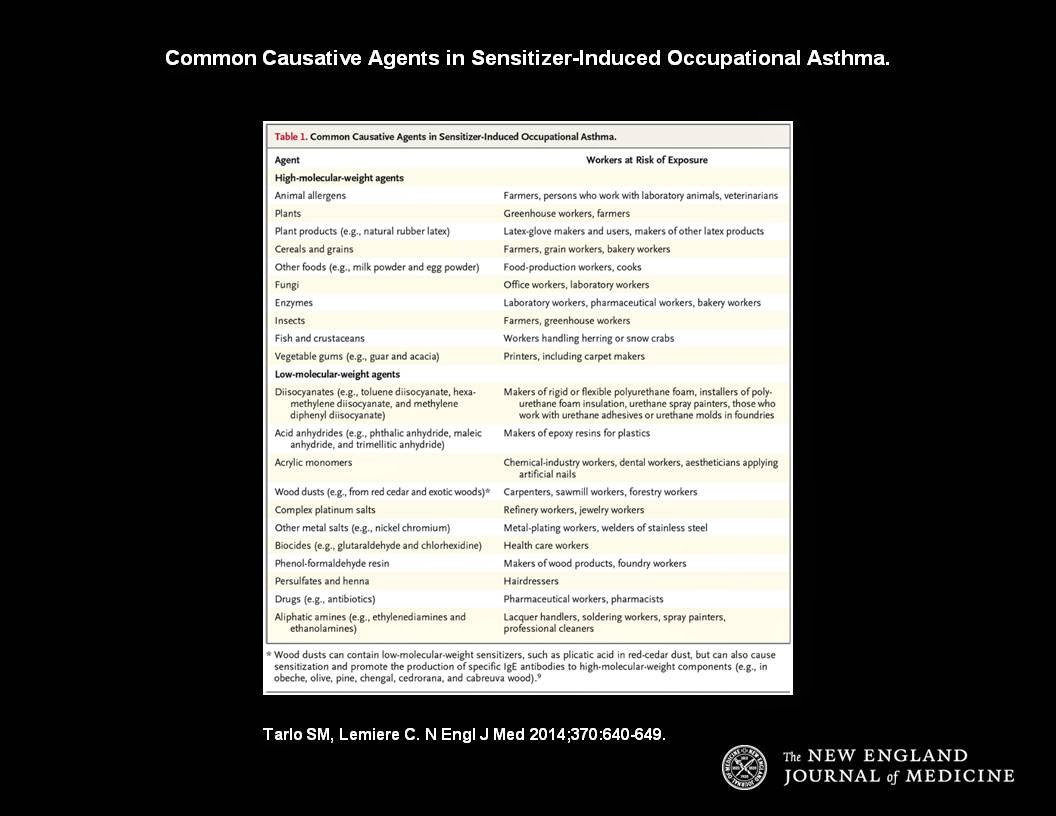
Occupational Asthma

Today we are presenting new review on Occupational Asthma from NEJM!
Asthma is common in the general population, including those in the workforce.Work exposures can cause or exacerbate asthma and can also be associated with asthma variants as well as symptoms that mimic asthma (e.g., the irritable larynx syndrome). In addition, even non–work-related asthma can affect the ability to work. This review focuses on current data about occupational asthma, defined as asthma due to conditions attributable to work exposures and not to causes outside the workplace.
http://www.nejm.org/doi/full/10.1056/NEJMra1301758

Occupational AsthmaSusan M. Tarlo, M.B., B.S., and Catherine Lemiere, M.D.N Engl J Med 2014; 370:640-649 February 13, 2014 DOI: 10.1056/NEJMra1301758

Sunday, April 27, 2014

You Can Control Your Asthma on World Asthma Day 2014

World Asthma Day is organized by the Global Initiative for Asthma (GINA) in collaboration with health care groups and asthma educators to raise awareness about asthma and improve asthma care throughout the world
Each year GINA chooses a theme and organizes preparation and distribution of World Asthma Day materials and resources. World Asthma Day activities are organized in each country by health care professionals, educators, and members of the public who want to help reduce the burden of asthma.
 
The first World Asthma Day, in 1998, was celebrated in more than 35 countries in conjunction with the first World Asthma Meeting held in Barcelona, Spain. Participation has increased with each World Asthma Day held since then, and the day has become one of the world's most important asthma awareness and education events.
https://www.facebook.com/events/582588928506007/
World Asthma Day 2014 will take place on Tuesday, May 6, 2014. The theme will be "You Can Control Your Asthma," continuing the emphasis on asthma control highlighted in past WAD events. The sub-theme, "It's Time to Control Asthma" will also be continued this year, with activity organizers encouraged to adapt the "It's Time to..." statement in ways relevant to their individual events. On World Asthma Day 2014 GINA will release a new, extensively revised version of the Global Strategy for Asthma Management and Prevention. 

Friday, April 18, 2014

Easter Greetings from Respiratory Decade

Dear Respiratory Decade friends,

We want to wish Happy Easter to you and your families!
We are grateful for your outstanding contribution to Respiratory Decade in the world and your continuing support of Respiratory Decade campaign!

Happy Birthday to CPAP!!!

Almost exactly 33 years after the publication of his pioneering paper on positive airway pressure for sleep apnoea (PAP) in The Lancet, Colin Sullivan continues to extend the boundaries of sleep medicine. In those three decades, PAP has gone from an obscure treatment available to few to an effective, portable treatment that has improved the sleep, and thus lifestyles, of millions worldwide.

Sullivan and his team undertook experiments with dogs on airway obstruction, and created a mask for use on human patients. Air pressure was controlled with a circuit that raised pressure until passive obstruction of the airway was cleared. His first test patient was a 43-year-old construction worker who did not want a tracheostomy—back then the only treatment. At very low pressures, PAP cleared the man's airway and allowed him to sink into a deeper sleep, as well as being sleep-free the next day. An elated Sullivan tried the technique on four other patients, and these findings formed the basis for his 1981 Lancet paper: Reversal of obstructive sleep apnoea by continuous positive airway pressure applied through the nares.

“When we were writing the paper,” says Dr. Sullivan, “we had no idea how many people had sleep apnea”.

Abstract from this great article: Five patients with severe obstructive sleep apnoea were treated with continuous positive airway pressure (CPAP) applied via a comfortable nose mask through the nares. Low levels of pressure (range 4·5-10 cm H2O) completely prevented upper airway occlusion during sleep in each patient and allowed an entire night of uninterrupted sleep. Continuous positive airway pressure applied in this manner provides a pneumatic splint for the nasopharyngeal airway and is a safe, simple treatment for the obstructive sleep apnoea syndrome.

Thursday, April 3, 2014

First EU summit on Chronic Diseases (3-4 April 2014)

Chronic diseases affect the sufferer over a long period of time and generally progress slowly. Some of them – cardiovascular diseases, cancer, chronic respiratory diseases, diabetes, mental illness – represent leading causes of mortality.
Tackling four major risk behaviours – smoking, alcohol abuse, unhealthy diet, sedentary lifestyle – can help prevent many chronic diseases. But to be effective, such efforts need to be based on targeted health promotion, prevention and early detection.
To efficiently address the challenge of chronic diseases, an integrated, horizontal approach is essential – involving all the relevant levels, from communities to policy makers.
Social and environmental determinants also play an important role in the development of chronic diseases, and there is a clear inequality in the burden of such conditions and in the access to prevention and control.

This first EU summit on chronic diseases will discuss medical, social and economic benefits of sustainable investments in health, ways to reduce the burden of chronic diseases, and how to strengthen the prevention and management of chronic diseases, with a focus on EU added value and action.
The first EU summit on chronic diseases brings together key policymakers, stakeholders and interest groups to explore ways to address chronic diseases effectively in the EU and to develop recommendations along the following questions:
  1. How does the expanding burden of chronic diseases affect the quality of life of citizens, the competitiveness of economies and the cohesion of societies and what can the EU do about it?
  2. How can the pressure of the expanding burden of chronic diseases on health systems be reduced and how can available resources be invested in the most efficient way?
  3. Which prevention measures are the most cost-effective in the short and in the long term, and how could they be implemented? How should the EU and its Member States promote their implementation? Which risk factors need to be addresses more efficiently?
  4. How do the health and care systems need to change to respond to the ageing challenge and growing phenomena of frailty and multi-morbidity?
  5. How to best reach, include and empower the most vulnerable and marginalised people successfully in prevention and care strategies?
  6. How could the European Union support Member States’ attempts towards containing the chronic disease burden? Which EU action would provide most added value – in economic, social and political terms?
http://ec.europa.eu/health/major_chronic_diseases/events/ev_20140403_en.htm
 
The summit will develop Conference conclusions and a set of policy recommendations for action clarifying on how the medical, social and economic burden of chronic diseases should be tackled in the European Union now and in the years to come