Thursday, May 22, 2014

Sleep and Breathing Barcelona 2015

The Sleep and Breathing conference is the largest pan-European meeting of its type and the only meeting offering an integrated approach to the investigation and treatment of sleep disorders.
In Barcelona 2015, the focus remains predominantly on sleep breathing disorders and our programme will cover as well other sleep-related areas of paediatrics, obesity, cardiovascular disorders, diabetes, psychology, psychiatry and neurology.
http://www.sleepandbreathing.org/

The Sleep and Breathing conference is coming after the great success in Berlin 2013.
 
The aim of the Sleep and Breathing Conference is to support the exchange of knowledge among the international scientific community. Writing an abstract for this conference is an important way for you to communicate your scientific research or clinical practice with your peers.


The conference is organised jointly by the European Respiratory Society and European Sleep Research Society and supported by other leading European societies that recognise the need for a transitional approach to the management of sleep disorders. This innovative, educational programme focuses on sleep and breathing disorders but will also provide significant insights into a wide range of related conditions.
The Sleep and Breathing Conference 2015 is the largest educational event of its kind in Europe and boasts a highly accomplished European faculty.
 

Friday, May 9, 2014

World No Tobacco Day - 31 May 2014

Raise taxes on tobacco

The global tobacco epidemic kills nearly 6 million people each year, of which more than 600 000 are non-smokers dying from breathing second-hand smoke. Unless we act, the epidemic will kill more than 8 million people every year by 2030. More than 80% of these preventable deaths will be among people living in low-and middle-income countries.
For World No Tobacco Day 2014, WHO and partners call on countries to raise taxes on tobacco.
https://www.facebook.com/events/706491222730461/?context=create&source=49#
 
Reduce tobacco consumption, save lives
 
Under the WHO Framework Convention on Tobacco Control (WHO FCTC), countries should implement tax and price policies on tobacco products as a way to reduce tobacco consumption. Research shows that higher taxes are especially effective in reducing tobacco use among lower-income groups and in preventing young people from starting to smoke. A tax increase that increases tobacco prices by 10% decreases tobacco consumption by about 4% in high-income countries and by up to 8% in most low- and middle-income countries.
Furthermore, increasing excise taxes on tobacco is considered to be the most cost-effective tobacco control measure. The World Health Report 2010 indicated that a 50% increase in tobacco excise taxes would generate a little more than US$ 1.4 billion in additional funds in 22 low-income countries. If allocated to health, government health spending in these countries could increase by up to 50%.

Goals

The ultimate goal of World No Tobacco Day is to contribute to protecting present and future generations not only from the devastating health consequences due to tobacco, but also from the social, environmental and economic scourges of tobacco use and exposure to tobacco smoke.
Specific goals of the 2014 campaign are that:
  • governments increase taxes on tobacco to levels that reduce tobacco consumption;
  • individuals and civil society organizations encourage their governments to increase taxes on tobacco to levels that reduce consumption.

Monday, May 5, 2014

2014 International Guidelines on Asthma: The Global Initiative for Asthma launched on World Asthma Day 2014

The Global Initiative for Asthma (GINA) today is launching a new edition of its Global Strategy for Asthma Management and Prevention, a comprehensive and practical resource about one of the most common chronic lung diseases worldwide. The first major revision of this document in eight years builds on a strong existing evidence base,and provides an integrated approach to diagnosing, assessing and managing asthma that spans all ages and can be adapted to national and local needs. The report is presented as an easy to use resource for managing problems that health professionals encounter every day across a wide range of health systems. 
http://www.ginasthma.org/local/uploads/files/GINA_Report_2014.pdf
 
“The new report reflects the latest science concerning the nature of asthma, an expanding interest in individualized health care, and greater awareness of the need for clinical recommendations to be feasible for implementation in clinical practice,” says Dr. Helen Reddel, Clinical Associate Professor at the Woolcock Institute of Medical Research in Sydney, Australia. “This is a real time of transition in our understanding of chronic airways disease and how to manage it to improve outcomes for the patient. ” As Chair of the GINA Science Committee, Dr. Reddel led the international group of asthma experts that produced the new report. The report is being released on World Asthma Day, an annual awareness raising event held the first Tuesday in May and organized by GINA. Dozens of events around the world will take place today around the theme “You Can Control Your Asthma.”

Pulmonary Hypertension like a “medical zebra”

Today is World Pulmonary Hypertension Day 2014!

Doctors often see patients with shortness of breath, chest pain, dizziness and fatigue. Often they diagnose this as asthma, sleep apnea or COPD. But sometimes these common symptoms indicate a rare and serious disease -- pulmonary hypertension (PH). PH is treatable, but because of misdiagnosis, many patients receive care too late. 
 

Sunday, May 4, 2014

World Pulmonary Hypertension Day 2014

5 May is World Pulmonary Hypertension Day!
The recognition and declaration of a World Pulmonary Hypertension Day is a step forward in the consolidation of a worldwide PH awareness. World PH Day will focus on the importance of improving the quality of life and life expectancy of more than 25 million people living with PH worldwide. Pulmonary hypertension can be a fatal disease that is difficult to diagnose. There are many types of PH, including idiopathic and hereditary PH, which are considered rare diseases. However, PH is most commonly the result of other health problems.
Regardless of type, pulmonary hypertension is defined as an increase in blood pressure in the pulmonary artery, pulmonary veins or pulmonary capillaries, together known as the lung vasculature. It is a severe disease with a markedly decreased exercise tolerance; pulmonary hypertension can also eventually lead to heart failure.

Objectives

During the celebration of World PH Day the patients' organizations will launch messages on the need to:
  • Increase awareness and disseminate knowledge of the disease to facilitate early diagnosis. Early diagnosis is important in decreasing premature PH-related deaths.
  • Promote access to specific healthcare and treatments that increase quality of life and life expectancy.
  • Promote the concept of treating PH patients as a whole, which includes treating their physical, psychological and social issues.
  • Unify international criteria for the recognition of Centers of Excellence in PH.
  • Promote research that will help find the cure for pulmonary hypertension.

History

In 2012, a program and a scientific symposium were held in Madrid, Spain as the first World PH Day celebration. The day was officially endorsed by 22 patient associations, 10 rare and affiliated disease organizations, and 8 scientific societies.
May 5 was originally chosen as World PH Day because it is the anniversary of the first child's death in Spain from pulmonary hypertension as a result of toxic rapeseed oil more than 30 years ago. 
Guidelines:
guidelines

Friday, May 2, 2014

A Tree of Hippocrates

A Tree of Hippocrates clone was planted in front of the National Library of Medicine on April 25, 2014. The first gene sequence of the tree, which can be used for scientific research, was unveiled during the dedication ceremony.
According to legend Hippocrates, regarded the father of modern medicine, taught students under a tree on the Greek island of Cos. When the library was dedicated in 1961, the Greek ambassador presented NLM with a cutting from a descendant of the Cos tree. The tree was planted the following spring. In the 1980s, NIH landscape architect Lynn Mueller detected signs of deterioration from weather and a fungal disease. He spent decades trying to restore the tree’s health while also exploring the possibility of a clone. He eventually connected with the Champion Tree Project, now the Archangel Ancient Tree Archive. Using cuttings from the gift tree, Archangel produced the clone that was planted. It replaces the gift tree which never recovered and was removed last year.
Greek Ambassador Christos Panagopoulos said: "It was 2,400 years ago on the small island of Cos that one of the brightest minds, not only of the period but throughout the ages, Hippocrates, used to gather his disciples around him under the shadow of a plane tree".

Thursday, May 1, 2014

Occupational Asthma

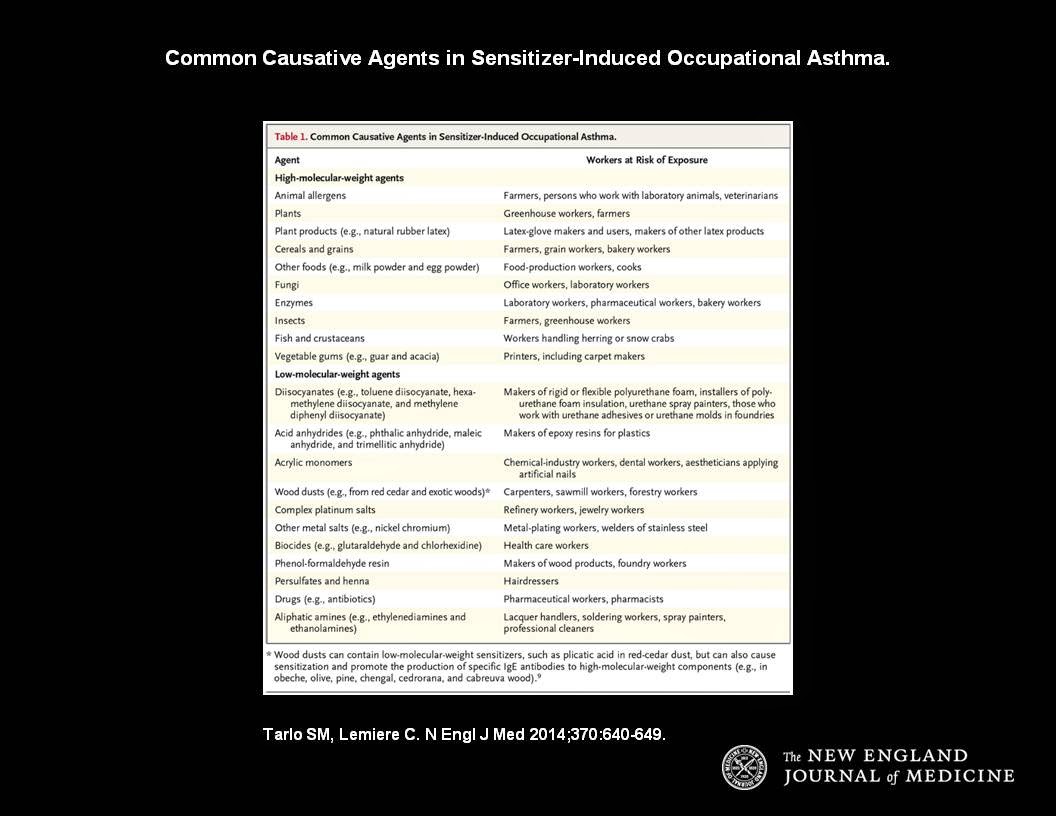
Today we are presenting new review on Occupational Asthma from NEJM!
Asthma is common in the general population, including those in the workforce.Work exposures can cause or exacerbate asthma and can also be associated with asthma variants as well as symptoms that mimic asthma (e.g., the irritable larynx syndrome). In addition, even non–work-related asthma can affect the ability to work. This review focuses on current data about occupational asthma, defined as asthma due to conditions attributable to work exposures and not to causes outside the workplace.
http://www.nejm.org/doi/full/10.1056/NEJMra1301758

Occupational AsthmaSusan M. Tarlo, M.B., B.S., and Catherine Lemiere, M.D.N Engl J Med 2014; 370:640-649 February 13, 2014 DOI: 10.1056/NEJMra1301758