Showing posts with label Sleep Medicine. Show all posts

Friday, August 14, 2015

Take A Nap (6 benefits of napping)

The stigma against napping is finally starting to wane - and for good reason. Taking a timeout to sleep during the day does much more than just give us a quick energy boost. It also confers some serious cognitive and health advantages as well.
Benefits of napping: 
  • prevents heart attacks 
  • Improved cognitive performance 
  • Increased alertness 
  • Improved memory 
  • Improved relaxation 
  • Stress reduction
Even a short 20 minute nap in the afternoon can provide all the benefits of napping. However, the length of your nap will determine what sort of benefits you’re likely to experience. According to the WebMD napping can be broken up into different categories:

20 Minute Nap – While a short 20 minute power nap does enhance memory, it has a more dramatic effect on mental alertness and motor learning skills.
20 To 30 Minute Nap – This length of nap will typically enhance creativity while at the same time also boosting memory.
30 To 60 Minute Nap – This type of nap has an incredibly beneficial impact one’s decision making skills. It also improves the part of your memory that’s responsible for memorizing things such as the alphabet; directions and etc.
60 To 90 Minute Nap – Taking this type of nap will ensure that you get REM (Rapid Eye Movement) sleep, and as such, this type of nap is the most beneficial of them all. Once you reach REM sleep, it’s almost as if the brain resets itself. One could say it’s like starting at the beginning again. Studies have shown that a 60 to 90 minute nap can have a dramatic effect on the brain in terms of problem solving. Here again, NASA has conducted their own studies, and they land up with the same result.

Sunday, December 7, 2014

Do you have Obstructive Sleep Apnea?

Most individual symptoms and signs have limited utility in determining the likelihood of OSA, and no one sign is sufficiently precise to rule in or rule out this condition. Although the absence of snoring makes a diagnosis of OSA less likely, snoring on its own is common and does not discriminate between those with and without OSA. Thus, snoring must be interpreted in the context of other symptoms and signs. Likewise, self-reported sleepinessandmorning headaches do not help discriminate among patients with and without OSA. It is somewhat surprising that the overall impression of sleep medicine physicians of the likelihood of OSA in individual patients does not perform much better than the limited utility of individual findings. It is important to recognize that persons with normal body weight who do not snore are unlikely to have OSA, and their complaints of daytime sleepiness or fatigue should prompt an evaluation for alternative diagnoses. 

Although the evidence shows that a number of recently published multi-itemed questionnaires may help rule out OSA, they are not helpful in identifying patients affected by sleep apnea. Fortunately, it appears that an explicit combination of only a few findings, expressed as the SACS, has promise for identifying patients most likely to have OSA. Although the test is seemingly easy to use, validation at current diagnostic thresholds in more general populations by primary care clinicians would provide important evidence to justify its use in routine screening.

Friday, November 7, 2014

Sleep and Breathing Barcelona 2015

Dear Respiratory Friends we are happy to invite to the Sleep and Breathing conference 2015!!!

The Sleep and Breathing conference is the largest pan-European meeting of its type and the only meeting offering an integrated approach to the investigation and treatment of sleep disorders.
In Barcelona 2015, the focus remains predominantly on sleep breathing disorders and our programme will cover as well other sleep-related areas of paediatrics, obesity, cardiovascular disorders, diabetes, psychology, psychiatry and neurology.
http://sleepandbreathing.org/


Thursday, October 16, 2014

How Much Sleep Does A Genius Need?

What the graph reveals is that exceptional minds generally have entirely un-exceptional sleep schedules. As you can see, most were in bed around 10:00pm and up not too long after dawn. And most were getting a solid seven or eight hours of sleep. There are studies that suggest that people are more creative at night or when they're tired, but clearly, even the world's greatest minds couldn't run on empty. Other than Balzac (who made up for his night-owlish ways during the evening and morning), very few geniuses were pulling all-nighters (although, we can't speak for their college years).

Saturday, September 27, 2014

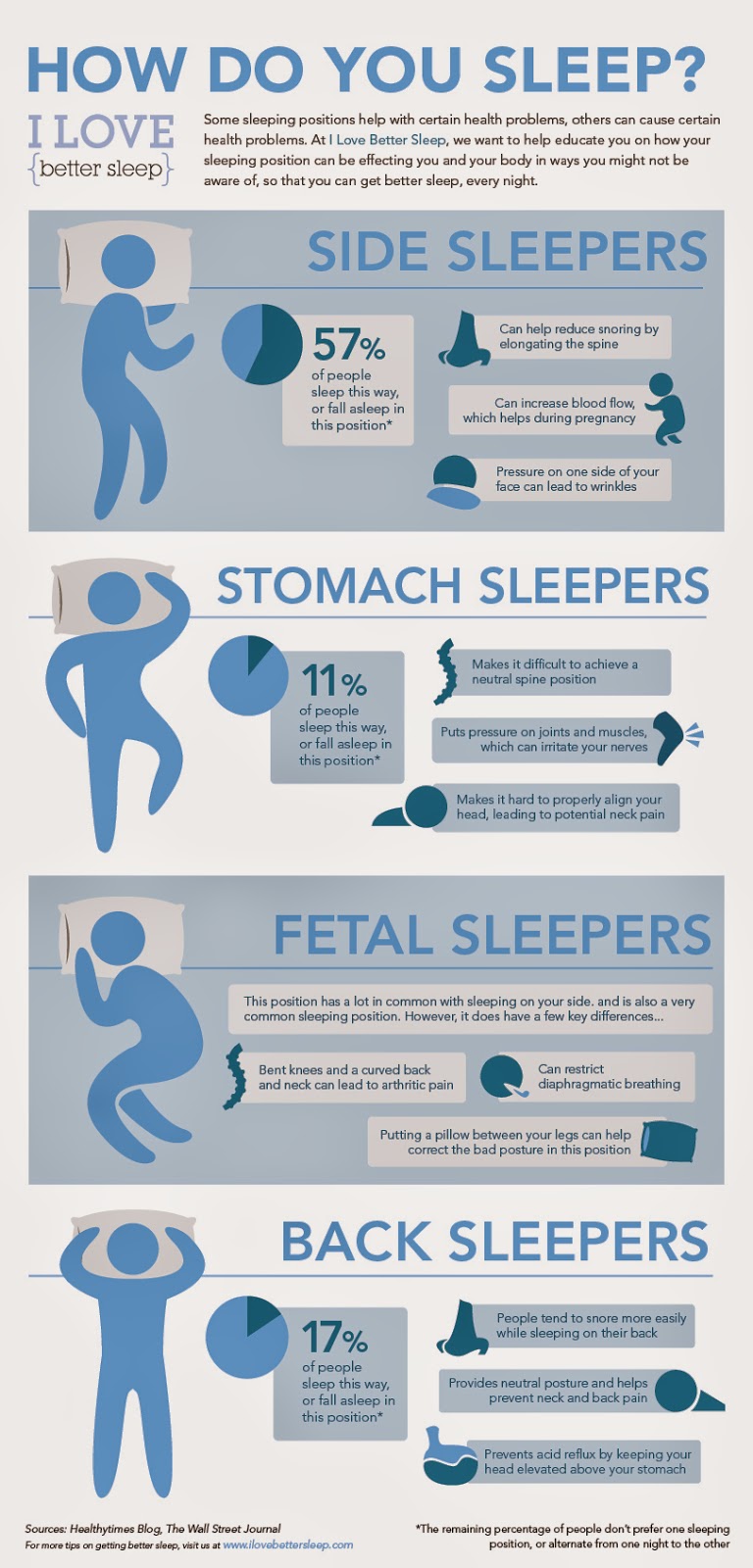
The 4 Most Common Sleeping Positions

How you sleep also affects your physical health. For example, the freefall position (lying on your front with your hands around the pillow and your head turned to one side) is good for digestion. But the "soldier" (lying on your back with both arms pinned to your sides) and the "starfish" may lead to snoring and a bad night's sleep.
Sleep apnea is worse when you sleep on your back, and other patients with leg cramps and restless legs syndrome restless legs syndrome have leg discomfort, so they tend to sleep in the fetal position and hold their legs.

Wednesday, September 24, 2014

The Science Of Sleeping

Today we are presenting infographic from Hufftington Post about gender differences in sleeping patterns and harmonious solutions for couples who are sharing a bed!!!

Sunday, September 21, 2014

The Best Sleep Position

Fatigue, sleep apnea, headaches, heartburn, and back pain are some of the complaints that can be aggravated by improper sleep posture and a bad night's sleep!

Sixty-three percent of people sleep on their side. Only 14% sleep on their back and 16% on their stomach. Which way is best?
Go with the flow. 
You may have heard that sleeping on your back prevents facial wrinkles because nothing is pushing against your face, but that doesn't mean you should change your snooze. Trying to change your natural sleep position can harm the quality of your sleep.
Mattress matters. 
The condition of your mattress will often dictate your sleep position. If you have an old, worn-out mattress that sags in the middle, sleeping on your side or stomach is more difficult.
Taking sides. 
The majority of people are side sleepers, but the jury is still out on which side -- left or right -- is more popular. Most people stick with one position, but that can shift as you age, usually due to health issues. Also, no one stays in one position all night, and doing so is not good for circulation.

Saturday, August 2, 2014

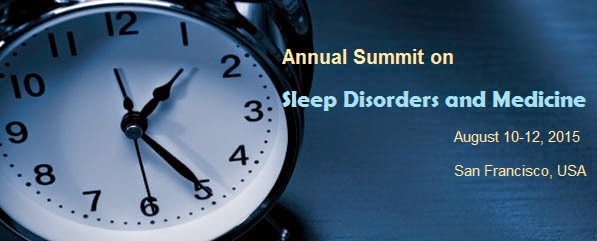
Welcome to Annual Summit on Sleep Disorders and Medicine 2015

Dear Respiratory friends today we are happy to invite you on a Great Respiratory event 2015! It is Annual Summit on Sleep Disorders and Medicine 2015 and it is organised by OMICS Group!
http://sleepmedicine.conferenceseries.net/#

OMICS Group invites you to attend the Annual Summit on Sleep Disorders and Medicine popularly known as Sleep Medicine 2015which is going to be held during August 10th -12th, 2015 at San Francisco, USA.
Sleep Disorders and Sleep Therapy is a cross-disciplinary area concerned with the psycological and physical health conditions related to sleep disorders and conventional and advanced sleep therapies . The main goal of Sleep Medicine 2015 is to illuminate the gravity of the topic, how it affects our day to day lives, prevention and stairway to a healthier tomorrow.
Sleep Medicine 2015 scientific sessions focuses on understanding sleep disorders and sleeping problems, medical conditions associated with sleep disorders, effect of sleep disorders on the human body, conventional sleep medicine and sleep therapy and exciting innovations in every area of Sleep Disorders and Advanced Sleep Therapies. Sleep Medicine 2015 encompasses the popularly known causes and types of sleep disorders and also reveals the underlying psychological disorders and other unknown causes for disrupted sleep patterns. Pediatric sleep disorders throws light upon the sleep disorders that can affect children and how it effects their development. Trends in sleep medicine will focus on a variety of medical and surgical specialties including Neurology, Pulmonary Medicine, Psychiatry, Otolaryngology, Dentistry Bariatric Surgery and Nutrition.
Sleep disorders range from insomnia disorder to narcolepsy and breathing-related disorders to restless legs syndrome. They are diagnosed through comprehensive assessment, which may entail a detailed patient history, physical exam, questionnaires and sleep diaries, and clinical testing. They often are addressed in similarly comprehensive ways involving behavioral, pharmacologic and other treatments in combination with medical care. 
Annual Summit on Sleep Disorders and Medicine, will be organized around the theme "Medical conditions related to sleep disorders and advanced sleep therapy." 
Sleep Medicine 2015 is comprised of 10 tracks and 48 sessions designed to offer comprehensive sessions that address current issues in Pharmaceutical Regulatory Affairs.
Submit your abstract to any of the following tracks:
http://sleepmedicine.conferenceseries.net/call-for-abstracts.php
All related abstracts are accepted.
http://sleepmedicine.conferenceseries.net/#
The Annual Summit on Sleep Disorders and Medicine will schedule and coordinate all meetings with our Editorial Board across the World. The scientific program paves a way to gather visionaries through the research talks and presentations and put forward many thought provoking information and therapeutic techniques related to Sleep Disorders.         
http://sleepmedicine.conferenceseries.net/#
The main aim of Sleep Medicine 2015 is to bring awareness amongst the people about the effect of sleep disorders on health, daily routine and lives, Symptoms people normally ignore diseases that can lead to sleep disorders, prevention and therapeutic techniques.
We look forward to seeing you in San Francisco!!

Tuesday, July 22, 2014

22nd Congress of the European Sleep Research Society

The European Sleep Research Society is an international scientific non-profit organisation whose purpose is to promote research on sleep and related areas, to improve the care for patients with sleep disorders and to facilitate the dissemination of information regarding sleep research and sleep medicine. 
http://www.esrs-congress.eu/esrs2014/home.html#&panel1-1

The Estonian Sleep Medicine Association is a young society, founded in 2005, and the ESRS is proud to host its congress in a region where sleep medicine and sleep research is developing at a fast pace. We are particularly happy that representatives of other Nordic sleep societies have accepted our invitation to join the local organising committee. Tallinn, the capital and largest city of Estonia, is considered to be Estonia’s crown jewel, boasts cobbled streets and rejuvenated 13th-century dwellings. Dozens of cafés and restaurants create an atmospheric retreat after exploring historic churches and scenic ruins, galleries and boutiques. Like most cities with an eight-hundred-year-old past, Tallinn is a patchwork of historic areas. The city’s pride and joy is without a doubt its Medieval Old Town with impressive and worth seeing monuments as Tallinn Town Hall which is the only Gothic style town hall left in Northern Europe, the Medieval Churches, Towers and Gates. Congress attendees will not only benefit from scientific exchange during the formal activities. Networking with colleagues with a mixture of backgrounds allows for identifying new research ideas and cooperation. The ESRS family is also about friendship and having fun; over the years many of us have established lasting friendships with colleagues from abroad, highlighting the international and truly European character of European Sleep Research Society.
 

Please click here to see the detailed, interactive programme of the ESRS 2014.

Thursday, May 22, 2014

Sleep and Breathing Barcelona 2015

The Sleep and Breathing conference is the largest pan-European meeting of its type and the only meeting offering an integrated approach to the investigation and treatment of sleep disorders.
In Barcelona 2015, the focus remains predominantly on sleep breathing disorders and our programme will cover as well other sleep-related areas of paediatrics, obesity, cardiovascular disorders, diabetes, psychology, psychiatry and neurology.
http://www.sleepandbreathing.org/

The Sleep and Breathing conference is coming after the great success in Berlin 2013.
 
The aim of the Sleep and Breathing Conference is to support the exchange of knowledge among the international scientific community. Writing an abstract for this conference is an important way for you to communicate your scientific research or clinical practice with your peers.


The conference is organised jointly by the European Respiratory Society and European Sleep Research Society and supported by other leading European societies that recognise the need for a transitional approach to the management of sleep disorders. This innovative, educational programme focuses on sleep and breathing disorders but will also provide significant insights into a wide range of related conditions.
The Sleep and Breathing Conference 2015 is the largest educational event of its kind in Europe and boasts a highly accomplished European faculty.
 

Friday, April 18, 2014

Happy Birthday to CPAP!!!

Almost exactly 33 years after the publication of his pioneering paper on positive airway pressure for sleep apnoea (PAP) in The Lancet, Colin Sullivan continues to extend the boundaries of sleep medicine. In those three decades, PAP has gone from an obscure treatment available to few to an effective, portable treatment that has improved the sleep, and thus lifestyles, of millions worldwide.

Sullivan and his team undertook experiments with dogs on airway obstruction, and created a mask for use on human patients. Air pressure was controlled with a circuit that raised pressure until passive obstruction of the airway was cleared. His first test patient was a 43-year-old construction worker who did not want a tracheostomy—back then the only treatment. At very low pressures, PAP cleared the man's airway and allowed him to sink into a deeper sleep, as well as being sleep-free the next day. An elated Sullivan tried the technique on four other patients, and these findings formed the basis for his 1981 Lancet paper: Reversal of obstructive sleep apnoea by continuous positive airway pressure applied through the nares.

“When we were writing the paper,” says Dr. Sullivan, “we had no idea how many people had sleep apnea”.

Abstract from this great article: Five patients with severe obstructive sleep apnoea were treated with continuous positive airway pressure (CPAP) applied via a comfortable nose mask through the nares. Low levels of pressure (range 4·5-10 cm H2O) completely prevented upper airway occlusion during sleep in each patient and allowed an entire night of uninterrupted sleep. Continuous positive airway pressure applied in this manner provides a pneumatic splint for the nasopharyngeal airway and is a safe, simple treatment for the obstructive sleep apnoea syndrome.

Monday, December 16, 2013

Writers Sleep Habits and Literary Productivity

Today we are happy to share with you infographic on Writers Sleep Habits and Literary Productivity!
“In both writing and sleeping,” Stephen King observed in his excellent meditation on the art of “creative sleep” and wakeful dreaming, “we learn to be physically still at the same time we are encouraging our minds to unlock from the humdrum rational thinking of our daytime lives.”

Friday, October 4, 2013

The best 2013 Sleep Story Video

The American Sleep Medicine Foundation selected an effects-heavy YouTube video about the benefits of sleep as the grand-prize winner of the first-ever ASMF Sleep Story Video Contest. The video was created by Jasper Lown, a senior at Wheaton-Warrenville South High School, located near Chicago. His two-minute video uses creative visuals to provide simple tips to improve sleep habits. His sponsoring teacher was Tim Brylka.