Tuesday, February 22, 2011

28th February 2011: World Rare Disease Day

February 28th 2011 will mark the fourth International Rare Disease Day coordinated by EURORDIS and organized with rare disease national alliances in 25 countries. On that day hundreds of patient organizations from more than 40 countries worldwide will be organizing awareness-raising activities and converging around the slogan:

“Rare but Equal”


While the average level of health in most parts of  the world have continued to improve over the last decades and huge progress has been made in scientific research and medical technology, health gaps amongst countries and within countries are widening, especially for the most vulnerable groups in society.

What about people living with rare diseases?

Every rare disease patient has his story of injustice to tell. For some of them it will be about obtaining life-saving treatments or being reimbursed, or about gaining access to specialized services or being considered eligible for disability compensation. Others have more difficulties finding a job, getting into school, obtaining a loan or accessing lifetime insurance.

From my point of view to define certain diseases as rare is not fully correct, as any patient suffers from a disease, no matter is it rare or widespread. That is a different perspective of seeing the problem. Defining some diseases as “rare” seems irrational, because namely those pathologies need more attention from both doctors and authorities all over the world.  

We appreciate the slogan used in American Rare Disease Day campaign :

Alone we are Rare. Together we are Strong.

Respiratory Decade is proud to be a partner of International Rare Disease Day.
 Together we are for:
•  Equal access for rare disease patients to health care and social services 
•  Equal access to basic social rights: health, education, employment, housing
•  Equal access to orphan drugs and treatments
Somebody can say that these diseases are invisible, but one can only presume the real number of patients with these “rare” pathologies. Being rare a disease never stops to be a disease, with its symptoms and consequences.


Wednesday, February 16, 2011

Stop the re-opening of Jeffrey Asbestos Mine! Stop mining and exporting Canadian asbestos!

PETITION: We are encouraging folks to “turn their anger to into action” and sign Noel’s petition. People are again outraged with Quebec’s Associate Deputy Minister for Mines response to our letter opposing the Jeffrey Mine funding/reopening online at http://bit.ly/hl4cUJ.

LETTER: Our blog with the Quebec’s letter is being shared with independent bloggers to maximize sharing, as seen with "Canadian Government Supports The Safe Use of Asbestos to maximize sharing http://pagroupuk.blogspot.com/2011/02/candian-government-supports-safe-use-of.html

TWITTER and FACEBOOK: Below are some of our petition micro-messages for anyone who may be interested in posting and sharing.
Turn Your Anger into Action – Sign the “Stop the re-opening of Jeffrey Asbestos Mine” petition today. http://bit.ly/eibOVZ#mesothelioma #cancer
Dare to Care – Sign the petition to stop the Jeffrey #Asbestos Mine from re-opening http://bit.ly/eibOVZ #mesothelioma #cancer
Stop the re-opening of Jeffrey #Asbestos Mine! Sign the petition today at http://bit.ly/eibOVZ #mesothelioma #cancer
Stop mining and exporting Canadian #asbestos! Sign the petition today at http://bit.ly/eibOVZ #mesothelioma #cancer 


In unity,

Linda Reinstein
Chief Executive Officer
Asbestos Disease Awareness Organization


"Asbestos is a Proven Carcinogen" 
Video Presentation by James Webber, PhD

ADAO's 7th Annual International Asbestos Awareness Conference brings together some of the world's greatest minds to discuss the impact of asbestos on public health, the environment, and the economy. To get an idea of the exceptional speakers you'll see this year, view last year's 2010 Asbestos Awareness Conference Video Presentation "Asbestos is a Proven Carcinogen" by James Webber, PhD.


Friday, February 11, 2011

European Respiratory Society Congress Amsterdam 2011

Chairs of European Respiratory Society (ERS) Congress Amsterdam 2011 Professors Elisabeth Bel and Peter Sterk say: "It is an honour to be able to welcome for the first time an ERS Annual Congress to Amsterdam, a city renowned for its cultural diversity, world-class museums and one of the world's great orchestras. And, after a full day of Congress sessions, there is nothing better than a stroll along one of the city's many beautiful tree-lined canals."


The 2011 ERS Congress is an unmatched opportunity to communicate your work, research and practices to thousands of your peers from Europe and overseas.

Submit your abstract TODAY at 

First time contributors can download our guide ‘How to write a good abstract - a few helpful hints’ at

Reminder! All abstracts to be submitted by 24 FEBRUARY 2011

For encouraging you I present a simple statistics from Moldova:


Abstract submission pulverizes all previous records!

6'540: that is the record-breaking number of abstracts submitted for the 2010 ERS Barcelona Congress, 
up a massive 21% on the previous record of 5,386, 
established in Vienna in 2009.


When submitting your abstract you can also apply for grants and sponsorships. 


Remember, the more abstracts for review and comment, the richer the Congress experience for all delegates!

Professors Elisabeth Bel and Peter Sterk state: "The ERS Annual Congress is the once-a-year occasion when the world's respiratory experts and professionals converge on a European city to meet, exchange views and share knowledge. We look forward to seeing you in Amsterdam, September 2011, capital of the Netherlands and, for five days, international capital of respiratory medicine and research."

Thank you for your vital contribution to this important event!


Dr. Alexandru Corlateanu
ERS National Delegate for Republic of Moldova

Friday, February 4, 2011

4 February 2011 is World Cancer Day: Returning to Hippocrates

Cancer is a leading cause of death around the world. World Health Organization estimates that 84 million people will die of cancer between 2005 and 2015 without intervention.
Each year on 4 February, World Health Organization supports International Union Against Cancer to promote ways to ease the global burden of cancer.
Cancer kills more people than AIDS, Malaria, and TB combined and without immediate, significant improvements - preventable/curable cancers will continue to kill millions of people worldwide. 
You can make difference! 


Respiratory Decade is encouraging you to sign the Declaration elaborated by the Union for International Cancer Control (UICC) which is the largest cancer fighting organization:
Help us reach our goal of 1,000,000 fans - your support will help us advocate for a cancer free world at the first United Nations Summit on Non Communicable Diseases in September 2011.


In the 1912 edition of his classic textbook of medicine, William Osler stated that "primary tumors of the lung are rare." Lung cancer is now the most common cause of cancer death in both men and women in the United States and is the leading cause of cancer death overall in the world, with over 1,000,000 deaths occurring yearly.
Smoking was suspected as causing lung cancer as early as the late 1920s, when physicians began seeing increasing numbers of patients with this heretofore rare disease and noted that nearly all were cigarette smokers.
In the Lung Health Study elegantly was demonstrated that risk for lung cancer decreases with smoking cessation, where the efficacy of smoking cessation interventions in decreasing lung cancer deaths was demonstrated in a prospective, controlled trial.


Another cause of lung cancer, which is also can be prevented, is asbestos!
In 1955 there was published scientific work demonstrating a highly persuasive association between heavy asbestos exposure and lung cancer.
Unfortunately, similar to tobacco, there was a very long delay between the documentation of the etiologic effect of asbestos in lung carcinogenesis and implementation of policies to protect the public. Problem of asbestos persists!

We will be happy if after some time, after considerable reduction and final elimination of tobacco products from the marketplace and elimination of asbestos from industry, next generations will return to the phrase of famous American surgeon Professor Johnston: "Hippocrates never heard of lung cancer"!

We can prevent lung cancer and 
raise quality of life for lung cancer patients!


Monday, January 31, 2011

The first international Sleep & Breathing Conference in Prague

From the 31st March to the 2nd April 2011 the European Respiratory Society and The ESRS (European Sleep and Research Society)  will be holding the first international Sleep & Breathing Conference in Prague.


These include:

·         Plenary sessions
Physiology
Pathophysilogy
Diagnostic and management approaches to sleep-disorderd breathing
Co-morbities in sleep apnoea
Hypersomnolence

·         Specialised symposia
Hot topics in sleep research
Hot topic on cutting research away from sleep apnoea
Sleep in chronic respiratory disorders
Management of non sleep apnoea patients
Neuropsychological consequences of sleep disordered breathing.

·         Parallel sessions

·         Hands-on training

Please see attached Advance Programme and go to site www.sleepandbreathing.org  for more information.
We are happy to invite all of you at the first international Sleep & Breathing Conference in Prague.


"In the last 20 years, Respiratory Sleep Medicine has evolved from hobby to hot spot of clinical practice and research. Targeting both leaders in the field of sleep medicine and those with educational needs, the conference will offer plenary sessions, reviews, practical workshops, free communication sessions and educational seminars."
Professor Johan Verbraecken


Saturday, January 22, 2011

Tuberculosis: a Global Perspective

On 20th September the press conference dedicated to the tuberculosis (TB) threats took place at the ERS Congress, Barcelona. The leading experts of respiratory medicine threw light upon epidemic challenge of TB infection.


Professor Davide Manissero, Professor Giovanni Battista Migliori and 
Professor Mario Raviglione

Professor Mario Raviglione spoke about TB control and WHO (World Health Organization) activity connected to tuberculosis, as namely under his guidance Stop TB Strategy of the WHO has been formulated. The question “How to establish international standards” was highly stressed by professor, because tuberculosis is preventable and curable, but the institution support, partnership between communities and health services varies from country to country. The lack of social justice and solidarity were represented as the society drawbacks which must be eliminated. Dr M. Raviglione mentioned the crucial role of vaccination as one of the most efficient preventive methods.


Professor Mario Raviglione

Professor Giovanni Battista Migliori, WHO Collaborating Centre for Control of TB and Lung Diseases presented a detailed overview of white plague in Europe and referred to the Top 19 countries with multidrug-resistant TB (MDR TB) cases according to WHO Stop TB Department (Azerbaijan, Republic of Moldova and Ukraine ranking the top three). Furthermore, the causes of MDR TB, such as inadequate regimes provided by health-care systems, inadequate supply or quality of drugs and inadequate drug intake were thoroughly explained and the patient’s mismanagement was emphasized as the ultimate consequence. Thereupon, Dr Migliori related facts about the independent clinical collaborative research in Europe TBNET that was founded in 2006 and is now present in 23 EU member states in order to promote clinically oriented research in the field of tuberculosis in Europe. In the long run Dr Migliori pointed out that “science is not enough” as human concern, awareness and care are undoubtedly indispensable.


Professor Giovanni Battista Migliori

The press conference went on due to the presentation of Professor Davide Manissero, Tuberculosis Programme Coordinator from the European Centre for Disease Prevention and Control who discussed the two main challenges: wider access to diagnosis and ensuring treatment outcome. Dr. Manissero summarized the plans of introducing new diagnostics and ensuring access to new opportunities and testing. Besides, the facts concerning low treatment success rate among MDR TB were emphasized and the list of new drugs for MDR TB was considered. 


Professor Davide Manissero

Finally, it was concluded that new diagnostics and new drugs need a solid base of knowledge of TB control basics, otherwise they will not be effective.
Corlateanu Liudmila*
member of International Francophone Press Union
1.       World Health Organization: Drug- and multidrug-resistant tuberculosis (MDR-TB) http://www.who.int/tb/challenges/mdr/en/index.html (accessed October 9, 2010)
2.       Working Group on New TB Drugs: www.newtbdrugs.org (accessed October 9, 2010)
3.       Evidence Based Tuberculosis Diagnosis: http://tbevidence.org/tbdxpl.htm (accessed October 9, 2010)

Thursday, January 20, 2011

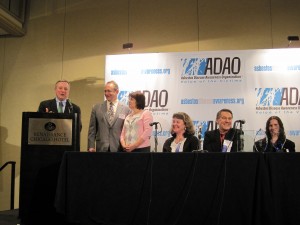
7th Annual International Asbestos Awareness Conference: Knowledge is Stronger than Asbestos!

We are happy to invite all of you at 7th Annual International Asbestos Awareness Conference “Asbestos: Impact on Public Health, Environment, and Economy” which will take place in April 1–3, 2011 in Atlanta, Georgia.
Conference is organized by official partner of Respiratory Decade - Asbestos Disease Awareness Organization (ADAO), the largest U.S. organization serving as the voice of asbestos victims.

The ADAO conference is one of the best educational and awareness opportunities for physicians, public health representatives, caregivers and other advocates.

http://www.asbestosdiseaseawareness.org/adao-conference/


Conference Schedule
Friday, April 1
Private Gathering for Family, Patients, & Caregivers Only
5:00 – 6:00 p.m. 
Friday, April 1
Meet and Greet with Jordan Zevon
7:00 – 9:00 p.m. 
Saturday, April 2
Conference
8:00 a.m. – 5:00 p.m. 
Sunday, April 3
Unity and Remembrance Brunch
9:30 – 11:30 a.m. 

Presentation by our friend Linda Reinstein co-founder of ADAO.


Knowledge is Stronger than Asbestos!

On behalf of Respiratory Decade International team
Alexandru Corlateanu