Saturday, August 20, 2016

Systematic Review of Errors in Inhaler Use: Has Patient Technique Improved Over Time? (Chest 2016 free full text)

Background  Problems with the use of inhalers by patients were noted shortly after the launch of the metered-dose inhaler (MDI) and persist today. We aimed to assess the most common errors in inhaler use over the past 40 years in patients treated with MDIs or dry powder inhalers (DPIs).
http://journal.publications.chestnet.org/article.aspx?articleid=2514047&resultClick=3

Methods  A systematic search for articles reporting direct observation of inhaler technique by trained personnel covered the period from 1975 to 2014. Outcomes were the nature and frequencies of the three most common errors; the percentage of patients demonstrating correct, acceptable, or poor technique; and variations in these outcomes over these 40 years and when partitioned into years 1 to 20 and years 21 to 40. Analyses were conducted in accordance with recommendations from Preferred Reporting Items for Systematic Reviews and Meta-Analyses and Strengthening the Reporting of Observational Studies in Epidemiology.
Results  Data were extracted from 144 articles reporting on a total number of 54,354 subjects performing 59,584 observed tests of technique. The most frequent MDI errors were in coordination (45%; 95% CI, 41%-49%), speed and/or depth of inspiration (44%; 40%-47%), and no postinhalation breath-hold (46%; 42%-49%). Frequent DPI errors were incorrect preparation in 29% (26%-33%), no full expiration before inhalation in 46% (42%-50%), and no postinhalation breath-hold in 37% (33%-40%). The overall prevalence of correct technique was 31% (28%-35%); of acceptable, 41% (36%-47%); and of poor, 31% (27%-36%). There were no significant differences between the first and second 20-year periods of scrutiny.
Conclusions  Incorrect inhaler technique is unacceptably frequent and has not improved over the past 40 years, pointing to an urgent need for new approaches to education and drug delivery.
Read more:
http://journal.publications.chestnet.org/article.aspx?articleid=2514047&resultClick=3

@respiratorydec supporting the #SentinelsofScience with @Publons this Peer Review Week 2016!

Publons is rewarding the heroes on the front lines of peer review for Peer Review Week 2016. Are you in the running? 
Expert peer reviewers are the Sentinels of Science. They protect the world from false findings that could set back advances in human knowledge by decades.
When researchers are committed to peer review, we discover cures, develop innovative technologies and realise human potential faster.
http://prw.publons.com/peer-review-week/
That’s why we’re saluting the Sentinels of Science for Peer Review Week 2016. At the end of Peer Review Week 2016, Publons will announce the top contributors to peer review over the past year, including the:
  • Top 10% of reviewers for each discipline
  • Top 3 overall contributors to peer review
  • Top 3 peer review contributors from the top five reviewing countries (by number)
  • Top 3 contributing editors (most manuscripts handled, by number)
  • Top 3 recognition advocates (top 3 editors that have invited reviewers to add a review record to Publons).
http://prw.publons.com/peer-review-week/
The top 10% of reviewers in each discipline will each receive a Sentinel Badge on their profile, signifying their commitment on the front lines of peer review over the past year.
Winners in all other categories will receive prizes from our biggest ever prize pool, thanks to contributions from our partners at: Wiley, Digital Science, ScholarOne and more.
So make sure your Publons profile is up to date with all your expert reviewing and editorial activity and get recognised as a true Sentinel of Science!

Friday, August 19, 2016

Survival after Endobronchial Valve Placement for Emphysema: A 10-Year Follow-up Study (article from American Journal of Respiratory and Critical Care Medicine)

We are happy to present you A 10-Year Follow-up Study of Survival after Endobronchial Valve Placement for Emphysema recently published in American Journal of Respiratory and Critical Care Medicine! This is one of the first long term follow up studies of Endobronchial Valves in Emphysema.
There is no effective therapy for advanced emphysema at present. Hence, to find novel therapeutic methods is needed. In the past decade, the new technology of bronchoscopic lung volume reduction with endobronchial valves (EBV) has been applied to clinical. Concerns of the less invasive bronchoscopic techniques to treat emphysema to achieve the similar beneficial effects to LVRS have been developed. Bronchoscopic lung volume reduction with EBV are one-way blocking devices that stop entry of air into the most affected emphysematous zone during inspiration while allowing it to escape during expiration in order to induce lobar atelectasis.
http://www.atsjournals.org/doi/abs/10.1164/rccm.201604-0852LE?url_ver=Z39.88-2003&rfr_id=ori:rid:crossref.org&rfr_dat=cr_pub%3dpubmed#.V7fwoqKbeUl
There are published several randomized controlled trials suggesting the role of EBV in patients with severe emphysema. Some non-controlled studies also demonstrated clinical improvements in lung volumes, health status and exercise tolerance. 


Thursday, August 18, 2016

@respiratorydec believe Respiratory Research deserve a broader audience!!!! Join #mobilizeresearch by Kudos

Respiratory decade believe Respiratory Research deserve a broader audience!!!! Join #mobilizeresearch campaign by Kudos!
https://twitter.com/respiratorydec
Kudos is a web-based service that helps researchers and their institutions and funders to maximize the visibility and impact of their published articles. Kudos provides a platform for assembling and creating information to help search filtering, for sharing information to drive discovery, and for measuring and monitoring the effect of these activities. 
Research can only reach its full potential if it is found, understood and applied – by those within the field, by researchers in other disciplines, by practitioners outside academia, even by the “curious public”. Taking a little time to increase the visibility of work is rising up the priority list for many researchers.
 
At Kudos, we’ve spent the last two years helping researchers explain and share their work to broaden its audience. A recent study has shown that usage of our tools is correlated to 23% higher usage of the publications being explained and shared.
Now, we’re putting our money where our mouth is and launching the “mobilization pledge” for researchers who share our belief that research deserves a broader audience. We’ll donate one penny to Open Knowledge International for everyone who signs up to the pledge by tweeting their commitment (#mobilizeresearch) or by disseminating their work via Kudos.
The campaign will run from now until the end of the year – but don’t wait! The sooner you join the campaign, the sooner you can help the word spread far and wide and ensure that we will be digging deep at the end of the year!
Sign up to “mobilize research” now – by doing one or both of the following:

Tuesday, August 9, 2016

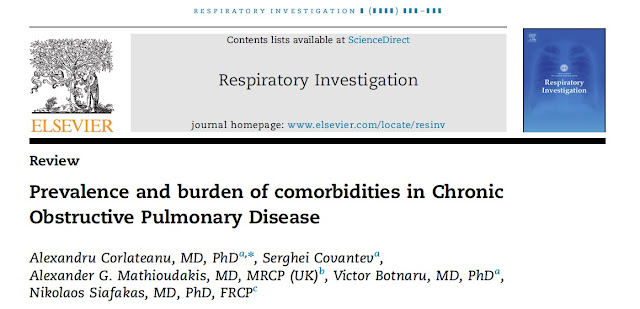
Prevalence and burden of comorbidities in COPD (article from Respiratory Investigation, 2016)

Dear Respiratory friends we are happy to present you our new article on Prevalence and burden of comorbidities in COPD which appeared today in Respiratory Investigation.
Abstract
The classical definition of Chronic Obstructive Pulmonary Disease (COPD) as a lung condition characterized by irreversible airway obstruction is outdated. The systemic involvement in patients with COPD, as well as the interactions between COPD and its comorbidities, justify the description of chronic systemic inflammatory syndrome. The pathogenesis of COPD is closely linked with aging, as well as with cardiovascular, endocrine, musculoskeletal, renal, and gastrointestinal pathologies, decreasing the quality of life of patients with COPD and, furthermore, complicating the management of the disease. The most frequently described comorbidities include skeletal muscle wasting, cachexia (loss of fat-free mass), lung cancer (small cell or non-small cell), pulmonary hypertension, ischemic heart disease, hyperlipidemia, congestive heart failure, normocytic anemia, diabetes, metabolic syndrome, osteoporosis, obstructive sleep apnea, depression, and arthritis. 
https://www.researchgate.net/publication/305995597_Prevalence_and_burden_of_comorbidities_in_Chronic_Obstructive_Pulmonary_Disease
These complex interactions are based on chronic low-grade systemic inflammation, chronic hypoxia, and multiple common predisposing factors, and are currently under intense research. This review article is an overview of the comorbidities of COPD, as well as their interaction and influence on mutual disease progression, prognosis, and quality of life.
Full text:
on Researchgate:

Saturday, August 6, 2016

Fevipiprant, a prostaglandin D2 receptor 2 antagonist, in patients with persistent eosinophilic asthma (Lancet article)

The clinical trial of Fevipiprant, conducted by experts at Leicester University, found that it led to a big drop in the the symptoms of asthma, improved sufferers’ lung function, reduced inflammation of the lungs and also helped to repair the lining of patients’ airways.

Background

Eosinophilic airway inflammation is often present in asthma, and reduction of such inflammation results in improved clinical outcomes. We hypothesised that fevipiprant (QAW039), an antagonist of prostaglandin D2 receptor 2, might reduce eosinophilic airway inflammation in patients with moderate-to-severe eosinophilic asthma.
http://www.thelancet.com/journals/lanres/article/PIIS2213-2600(16)30179-5/abstract

Methods

We performed a single-centre, randomised, double-blind, parallel-group, placebo-controlled trial at Glenfield Hospital (Leicester, UK). We recruited patients with persistent, moderate-to-severe asthma and an elevated sputum eosinophil count (≥2%). After a 2-week single-blind placebo run-in period, patients were randomly assigned (1:1) by the trial pharmacist, using previously generated treatment allocation cards, to receive fevipiprant (225 mg twice per day orally) or placebo, stratified by the use of oral corticosteroid treatment and bronchoscopy. The 12-week treatment period was followed by a 6-week single-blind placebo washout period. The primary outcome was the change in sputum eosinophil percentage from baseline to 12 weeks after treatment, analysed in the intention-to-treat population. All patients who received at least one dose of study drug were included in the safety analyses. This trial is registered with ClinicalTrials.gov, number NCT01545726, and with EudraCT, number 2011-004966-13.

Findings

Between Feb 10, 2012, and Jan 30, 2013, 61 patients were randomly assigned to receive fevipiprant (n=30) or placebo (n=31). Three patients in the fevipiprant group and four patients in the placebo group withdrew because of asthma exacerbations. Two patients in the fevipiprant group were incorrectly given placebo (one at the mid-treatment visit and one throughout the course of the study). They were both included in the fevipiprant group for the primary analysis, but the patient who was incorrectly given placebo throughout was included in the placebo group for the safety analyses. Between baseline and 12 weeks after treatment, sputum eosinophil percentage decreased from a geometric mean of 5·4% (95% CI 3·1–9·6) to 1·1% (0·7–1·9) in the fevipiprant group and from 4·6% (2·5–8·7) to 3·9% (CI 2·3–6·7) in the placebo group. Compared with baseline, mean sputum eosinophil percentage was reduced by 4·5 times in the fevipiprant group and by 1·3 times in the placebo group (difference between groups 3·5 times, 95% CI 1·7–7·0; p=0·0014). Fevipiprant had a favourable safety profile, with no deaths or serious adverse events reported. No patient withdrawals were judged by the investigator to be related to the study drug.

Interpretation

Fevipiprant reduces eosinophilic airway inflammation and is well tolerated in patients with persistent moderate-to-severe asthma and raised sputum eosinophil counts despite inhaled corticosteroid treatment.
Full text:

2016 Clinical Practice Guideline From the American College of Physicians - Management of Chronic Insomnia Disorder in Adults (free full text)

Description: The American College of Physicians (ACP) developed this guideline to present the evidence and provide clinical recommendations on the management of chronic insomnia disorder in adults.
http://annals.org/article.aspx?articleid=2518955

Methods: This guideline is based on a systematic review of randomized, controlled trials published in English from 2004 through September 2015. Evaluated outcomes included global outcomes assessed by questionnaires, patient-reported sleep outcomes, and harms. The target audience for this guideline includes all clinicians, and the target patient population includes adults with chronic insomnia disorder. This guideline grades the evidence and recommendations by using the ACP grading system, which is based on the GRADE (Grading of Recommendations Assessment, Development and Evaluation) approach.
Recommendation 1: ACP recommends that all adult patients receive cognitive behavioral therapy for insomnia (CBT-I) as the initial treatment for chronic insomnia disorder. (Grade: strong recommendation, moderate-quality evidence)
Recommendation 2: ACP recommends that clinicians use a shared decision-making approach, including a discussion of the benefits, harms, and costs of short-term use of medications, to decide whether to add pharmacological therapy in adults with chronic insomnia disorder in whom cognitive behavioral therapy for insomnia (CBT-I) alone was unsuccessful. (Grade: weak recommendation, low-quality evidence)
Free full text:
http://annals.org/article.aspx?articleid=2518955