Showing posts with label MDR-TB. Show all posts

Saturday, March 25, 2017

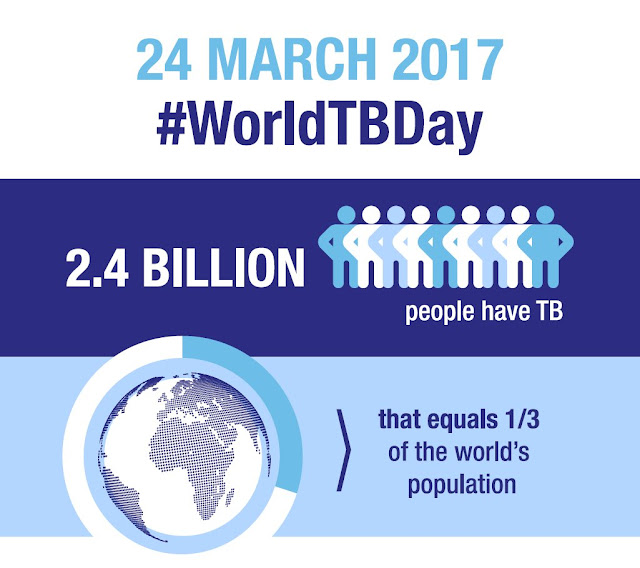
World TB Day 2017 (special Lancet 2017 article)

Global tuberculosis incidence has declined marginally over the past decade, and tuberculosis remains out of control in several parts of the world including Africa and Asia. Although tuberculosis control has been effective in some regions of the world, these gains are threatened by the increasing burden of multidrug-resistant (MDR) and extensively drug-resistant (XDR) tuberculosis. XDR tuberculosis has evolved in several tuberculosis-endemic countries to drug-incurable or programmatically incurable tuberculosis (totally drug-resistant tuberculosis). 
http://www.thelancet.com/journals/lanres/article/PIIS2213-2600(17)30079-6/fulltext
This poses several challenges similar to those encountered in the pre-chemotherapy era, including the inability to cure tuberculosis, high mortality, and the need for alternative methods to prevent disease transmission. This phenomenon mirrors the worldwide increase in antimicrobial resistance and the emergence of other MDR pathogens, such as malaria, HIV, and Gram-negative bacteria. MDR and XDR tuberculosis are associated with high morbidity and substantial mortality, are a threat to health-care workers, prohibitively expensive to treat, and are therefore a serious public health problem. In this Commission, we examine several aspects of drug-resistant tuberculosis. The traditional view that acquired resistance to antituberculous drugs is driven by poor compliance and programmatic failure is now being questioned, and several lines of evidence suggest that alternative mechanisms—including pharmacokinetic variability, induction of efflux pumps that transport the drug out of cells, and suboptimal drug penetration into tuberculosis lesions—are likely crucial to the pathogenesis of drug-resistant tuberculosis. These factors have implications for the design of new interventions, drug delivery and dosing mechanisms, and public health policy. We discuss epidemiology and transmission dynamics, including new insights into the fundamental biology of transmission, and we review the utility of newer diagnostic tools, including molecular tests and next-generation whole-genome sequencing, and their potential for clinical effectiveness. Relevant research priorities are highlighted, including optimal medical and surgical management, the role of newer and repurposed drugs (including bedaquiline, delamanid, and linezolid), pharmacokinetic and pharmacodynamic considerations, preventive strategies (such as prophylaxis in MDR and XDR contacts), palliative and patient-orientated care aspects, and medicolegal and ethical issues.

Monday, March 24, 2014

World Tuberculosis Day 2014: Consensus statement on the management of patients with MDR-TB and XDR-TB in Europe

Today, the European Respiratory Journal has released the publication of the TBnet consensus statement on the management of patients with MDR-TB and XDR-TB in Europe. The manuscript can be accessed online and  free of charge.
You will find important facts and information on the management of your patients as well as recommendations for therapy monitoring and documentation.

Saturday, March 22, 2014

2014 World Tuberculosis Day

For the 2014 World TB (Tuberculosis) Day on 24 March 2014 many individuals, groups and organizations are standing together to spread the message of ZERO STIGMA. As the international leader in the fight against TB, Dr. Mario Raviglione, the director of the Global TB Programme at the WHO shared this ZERO STIGMA message. Take up his call to action and join the cause! 

Friday, October 25, 2013

New Guidelines of Treatment of Multidrug-Resistant Tuberculosis

Dear Respiratory we are happy to present New Guidelines of Treatment of Multidrug-Resistant Tuberculosis!
It can be a Revolution in treatment of Multidrug-Resistant Tuberculosis!

Multidrug-resistant tuberculosis (MDR TB) is caused by Mycobacterium tuberculosis that is resistant to at least isoniazid and rifampin, the two most effective of the four first-line TB drugs (the other two drugs being ethambutol and pyrazinamide). MDR TB includes the subcategory of extensively drug-resistant TB (XDR TB), which is MDR TB with additional resistance to any fluoroquinolone and to at least one of three injectable anti-TB drugs (i.e., kanamycin, capreomycin, or amikacin). MDR TB is difficult to cure, requiring 18–24 months of treatment after sputum culture conversion with a regimen that consists of four to six medications with toxic side effects, and carries a mortality risk greater than that of drug-susceptible TB.
Bedaquiline fumarate (Sirturo or bedaquiline) is an oral diarylquinoline. On December 28, 2012, on the basis of data from two Phase IIb trials (i.e., well-controlled trials to evaluate the efficacy and safety of drugs in patients with a disease or condition to be treated, diagnosed, or prevented), the Food and Drug Administration (FDA) approved use of bedaquiline under the provisions of the accelerated approval regulations for "serious or life-threatening illnesses" (21CFR314.500) (Cox EM. FDA accelerated approval letter to Janssen Research and Development.

Thursday, June 27, 2013

The MDR-TB Time bomb: Identifying the real risk of drug resistant tuberculosis in Europe

Today we are sharing with you video about tuberculosis produced by European Respiratory Society!
A critical update from Europe's leading specialists on the increasing threat of multidrug-resistant tuberculosis.
Using the latest statistics and patient experiences the film highlights the risk to the European population and the region's health systems.
Experts in the field of TB share their recommendations, investigate on-going inspirational initiatives and call on all stakeholders in respiratory medicine to take action to manage the disease and the factors that contribute to its progress in the community.